
Interfaces for Personal Identity Verification (Working Draft)
Part 2 – PIV Card Application Card Command Interface
Abstract
FIPS 201 defines the requirements and characteristics of government-wide interoperable identity credentials. It specifies that these identity credentials must be stored on a smart card and that additional common identity credentials, known as derived PIV credentials, may be issued by a federal department or agency and used when a PIV Card is not practical. This document contains the technical specifications to interface with the smart card to retrieve and use the PIV identity credentials. The specifications reflect the design goals of interoperability and PIV Card functions. The goals are addressed by specifying a PIV data model, card edge interface, and application programming interface. Moreover, this document enumerates requirements for the options and branches in international integrated circuit card standards 23456. The specifications go further by constraining interpretations of the normative standards to ease implementation, facilitate interoperability, and ensure performance in a manner tailored for PIV applications.
1Introduction
Homeland Security Presidential Directive-12 (HSPD-12) called for the adoption of a common identification standard to govern the interoperable use of identity credentials to allow physical and logical access to federally controlled facilities and information systems. In response, Federal Information Processing Standard (FIPS) 201, Personal Identity Verification (PIV) of Federal Employees and Contractors 7, was developed to define reliable, government-wide identity credentials for use in applications such as access to federally controlled facilities and information systems. FIPS 201 supports multiple types of authenticators, including authenticators on smart cards (also known as PIV cards) and derived PIV credential authenticators in various other form factors. This publication contains technical specifications to interface with PIV Cards to retrieve and use identity credentials. Other specifications, such as NIST Special Publication (SP) 800-157r1 (Revision 1), contain procedures and life cycle activities to issue, maintain, and use derived PIV credentials.
1.1Purpose
FIPS 201 defines processes for binding identities to authenticators, such as the PIV Card and derived PIV credentials used in the federal PIV system. SP 800-73-5 contains the technical specifications to interface with the PIV Card to retrieve and use the identity credentials. The specifications reflect the design goals of interoperability and PIV Card functions. The goals are addressed by specifying a PIV data model, card edge interface, and application programming interface. Moreover, SP 800-73-5 enumerates requirements for the options and branches in international integrated circuit card (ICC) standards 23456. The specifications go further by constraining interpretations of the normative standards to ease implementation, facilitate interoperability, and ensure performance in a manner tailored for PIV applications.
1.2Scope
SP 800-73-5 specifies the PIV data model, application programming interface (API), and card interface requirements necessary to comply with the use cases, as defined in Section 6 of FIPS 201 and further described in Appendix B of SP 800-73-5 Part 1. Interoperability is defined as the use of PIV identity credentials such that client-application programs, compliant card applications, and compliant ICCs CAN be used interchangeably by all information processing systems across federal agencies. SP 800-73-5 defines the PIV data elements’ identifiers, structure, and format, as well as the client API and card command interface for use with the PIV Card.
This document — SP 800-73-5, Interfaces for Personal Identity Verification: Part 2 – PIV Card Application Card Command Interface — contains the technical specifications for the PIV Card command interface to the PIV Card. The specifications define the set of commands surfaced by the PIV Card Application at the card edge of the ICC.
1.3Audience and Assumptions
This document is intended for federal agencies and implementers of PIV systems. Readers are assumed to have a working knowledge of smart card standards and applications.
Readers should also be aware of the following important content in SP 800-73-5 Part 1:
The front matter describes configuration management recommendations.
Section 1.3 specifies the effective date of SP 800-73-5.
The front matter also specifies NPIVP conformance testing procedures.
Appendix G provides the full Revision History of SP 800-73.
1.4Content and Organization
All sections in this document are normative (i.e., mandatory for compliance) unless specified as informative (i.e., non-mandatory) and are structured as follows:
Section 1, Introduction, provides the purpose, scope, audience, and assumptions of the document and outlines its structure.
Section 2, Overview: Concepts and Constructs, describes the model of computation of the PIV Card Application and the PIV client application programming interface, including information processing concepts and data representation constructs.
Section 3, PIV Card Application Card Command Interface, describes the set of commands accessible by the PIV Middleware to communicate with the PIV Card Application.
Section 4, Secure Messaging, describes the secure messaging protocol that is used to enable data confidentiality and integrity.
Appendix A demonstrates the GENERAL AUHTENTICATE command. This section is informative.
Appendix B contains the list of acronyms used in this document. This section is informative.
Appendix C contains a Glossary of terms used in this document. This section is informative.
Appendix D explains the notation in use in this document. This section is informative.
2Overview: Concepts and Constructs
SP 800-73-5 Parts 2 and 3 define two interfaces to an ICC that contain the PIV Card Application: a low-level card command interface (Part 2) and a high-level client API (Part 3). SP 800-73-5 Part 3 is optional, and NIST Personal Identity Verification Program (NPIVP) conformance testing for PIV Middleware in accordance with SP 800-73 Part 3 is discontinued since endpoints support high-level client API natively at the time of this publication.
The information processing concepts and data constructs on both interfaces are identical and MAY be referred to generically as the information processing concepts and data constructs on the PIV interfaces without specific reference to the client API or the card command interface.
The client API provides task-specific programmatic access to these concepts and constructs, and the card command interface provides communication access. The client API is used by client applications using the PIV Card Application. The card command interface is used by software that implement the client API (middleware).
The client API is thought of as being at a higher level than the card command interface because access to a single entry point on the client API may cause multiple card commands to traverse the card command interface. In other words, it may require more than one card command on the card command interface to accomplish the task represented by a single call on an entry point of the client API.
The client API is a program execution, call/return style interface, whereas the card command interface is a communication protocol, command/response style interface. Because of this difference, the representation of the PIV concepts and constructs as bits and bytes on the client API may be different from the representation of these same concepts and constructs on the card command interface.
2.1Platform Requirements
The PIV Card Application places the following requirements on the ICC platform on which it is implemented or installed:
Global security status that includes the security status of a global cardholder PIN
Application selection using a truncated Application Identifier (AID)
Ability to reset the security status of an individual application
Indication to applications as to which physical communication interface — contact versus contactless — is in use
Support for the default selection of an application upon warm or cold reset
2.2Namespaces of the PIV Card Application
Part 1 specifies the AID, names, Tag-Length-Value (BER-TLV) tags 8, ASN.1 Object Identifiers (OIDs) 9, and Proprietary Identifier eXtensions (PIXes) of the NIST Registered Application Provider IDentifier (RID) used on the PIV interfaces. Part 1 also states that all unspecified names, BER-TLV tags, OIDs, and values of algorithm identifiers, key references, and cryptographic mechanism identifiers are reserved for future use.
2.3Card Applications
Each command that appears on the card command interface SHALL be implemented by a card application that is resident on the ICC. The card command enables operations on and with the data objects to which the card application has access.
Each card application SHALL have a globally unique name called its Application Identifier (AID) 2. Except for the default applications, access to the card commands and data objects of a card application SHALL be gained by selecting the card application using its application identifier.[1] The PIX of the AID SHALL contain an encoding of the version of the card application. The AID of the PIV Card Application is defined in Part 1.
The card application whose commands are currently being used is called the currently selected application.
2.3.1Default Selected Card Application
The card platform SHALL support a default selected card application. In other words, there SHALL be a currently selected application immediately after a cold or warm reset. This card application is the default selected card application. The default card application MAY be the PIV Card Application, or it MAY be another card application.
2.4Security Architecture
The security architecture of an ICC is the means by which the security policies governing access to each data object stored on the card are represented within the card. These security policy representations are applied to all PIV card commands, thereby ensuring that the prescribed data policies for the card applications are enforced.
The following subsections describe the security architecture of the PIV Card Application.
2.4.1Access Control Rule
An access control rule SHALL consist of an access mode and a security condition. The access mode is an operation that CAN be performed on a data object. A security condition is a Boolean expression using variables called security statuses (see Section 2.4.2).
According to an access control rule, the action described by the access mode CAN be performed on the data object if and only if the security condition evaluates to TRUE for the current values of the security statuses. If there is no access control rule with an access mode that describes a particular action, then that action SHALL never be performed on the data object.
2.4.2Security Status
A set of one or more Boolean variables — each called a security status indicator of the authenticable entity — SHALL be associated with each authenticable entity. Each security status indicator is, in turn, associated with a credential that CAN be used to authenticate the entity. The security status indicator of an authenticable entity SHALL be TRUE if the credentials associated with the security status indicator of the authenticable entity have been authenticated and FALSE otherwise.
A successful execution of an authentication protocol SHALL set the security status indicator associated with the credential used in the protocol to TRUE. An aborted or failed execution of an authentication protocol SHALL set the security status indicator associated with the credential used in the protocol to FALSE.
As an example, the credentials associated with three security status indicators of the cardholder might be a PIN, fingerprint, and pairing code. Demonstrating knowledge of the PIN is the authentication protocol for the first security status indicator wherein the PIN is the credential. Comparing the fingerprint template on the card with a fingerprint acquired from the cardholder is the authentication protocol for the second security status indicator wherein the fingerprint is the credential. Demonstrating knowledge of the pairing code is the authentication protocol for the third security status indicator wherein the pairing code is the credential. A security condition using these three security status indicators might be “pairing code AND (PIN OR fingerprint).”
A security status indicator SHALL be said to be a global security status indicator if it is not changed when the currently selected application changes from one application to another. In essence, when changing from one application to another, the global security status indicators SHALL remain unchanged.
A security status indicator is said to be an application security status indicator if it is set to FALSE when the currently selected application changes from one application to another. Every security status indicator is either a global security status indicator or an application security status indicator. The security status indicators associated with the PIV Card Application PIN, the PIN Unblocking Key (PUK), OCC, pairing code, and the PIV Card Application Administration Key are application security status indicators for the PIV Card Application, whereas the security status indicator associated with the Global PIN is a global security status indicator.
The term global security status refers to the set of all global security status indicators. The term application security status refers to the set of all application security status indicators for a specific application.
2.4.3Authentication of an Individual
Knowledge of a PIN is the means by which an individual CAN be authenticated to the PIV Card Application.
The pairing code SHALL be exactly 8 bytes in length, and the PIV Card Application PIN SHALL be between 6 and 8 bytes in length. If the actual length of the PIV Card Application PIN is less than 8 bytes, it SHALL be padded to 8 bytes with 0xFF when presented to the card command interface. The ‘FF’ padding bytes SHALL be appended to the actual value of the PIN. The bytes that comprise the PIV Card Application PIN and pairing code SHALL be limited to values 0x30 – 0x39, the ASCII values for the decimal digits ‘0’ – ‘9’. For example:
Actual PIV Card Application PIN: “123456” or
31 32 33 34 35 36Padded PIV Card Application PIN presented to the card command interface:
31 32 33 34 35 36 FF FF
The PIV Card Application SHALL enforce the minimum length requirement of 6 bytes for the PIV Card Application PIN (i.e., SHALL verify that at least the first 6 bytes of the value presented to the card command interface are in the range 0x30 – 0x39) and the other formatting requirements specified in this section.
If the Global PIN is used by the PIV Card Application, then the above encoding, length, padding, and enforcement of minimum PIN length requirements for the PIV Card Application PIN SHALL apply to the Global PIN.
The PUK SHALL be 8 bytes in length and MAY be any 8-byte binary value. That is, the bytes that comprise the PUK MAY have any value in the range 0x00 – 0xFF.
2.5Current State of the PIV Card Application
The elements of the current state of the PIV Card Application when the PIV Card Application is the currently selected application are described in Table 1.
Table 1:State of the PIV Card Application
| State Name | Always Defined | Comment | Location of State |
|---|---|---|---|
| Global security status | Yes | Contains security status indicators that span all card applications on the platform | PIV Platform |
| Currently selected application | Yes | The platform SHALL support the selection of a card application using the full application identifier or by providing the right-truncated version, and there SHALL always be a currently selected application. | PIV Platform |
| Application security status | Yes | Contains security status indicators local to the PIV Card Application | PIV Card Application |
3PIV Card Application Card Command Interface
Table 2 lists the card commands surfaced by the PIV Card Application at the card edge of the ICC when it is the currently selected card application[2][3]. All PIV Card Application card commands SHALL be supported by a PIV Card Application. Card commands indicated by a “Yes” in the Command Chaining column SHALL support command chaining for transmitting a data string that is too long for a single command, as defined in 2.
Table 2:PIV Card Application card commands
| Type | Name | Contact Interface | Contactless Interface | Security Condition for Use | Command Chaining |
|---|---|---|---|---|---|
| Data Access | SELECT | Yes | Yes | Always | No |
| Data Access | GET DATA | Yes | Yes | Data Dependent. See Table 2, Part 1. | No |
| Authentication | VERIFY | Yes | SM or VCI (see Note 1) | Always | Yes |
| Authentication | CHANGE REFERENCE DATA | Yes | VCI | PIN or OCC | Yes |
| Authentication | RESET RETRY COUNTER | Yes | No | PIN Unblocking Key | No |
| Authentication | GENERAL AUTHENTICATE | Yes | Yes (See Note 2) | Key Dependent. See Table 5, Part 1. | Yes |
| Credential Init. & Admin. | PUT DATA | Yes | No | PIV Card Application Administrator | Yes |
| Credential Init. & Admin. | GENERATE ASYMMETRIC KEY PAIR | Yes | No | PIV Card Application Administrator | Yes |
The PIV Card Application shall return the status word of 6A 81 (Function not supported) when it receives a card command on the contactless interface marked “No” in the Contactless Interface column in Table 2. The PIV Card Application may return a different status word (e.g., 69 82) if the card command can be performed over the contactless interface in support of card management. The PIV Card Application will only perform the command in support of card management if the requirements specified in Section 2.9.2 of FIPS 201-2 are satisfied.
3.1PIV Card Application Card Commands for Data Access
3.1.1SELECT Card Command
The SELECT card command sets the currently selected application. The PIV Card Application SHALL be selected by providing its application identifier (see Part 1, Section 2.2) in the data field of the SELECT command.
There SHALL be at most one PIV Card Application on any ICC. The PIV Card Application CAN also be made the currently selected application by providing the right-truncated version (see Part 1, Section 2.2) — that is, without the 2-byte version number in the data field of the SELECT command.
The complete AID of the PIV Card Application – including the 2-byte version – that became the currently selected card application upon successful execution of the SELECT command (using the full or right-truncated PIV AID) SHALL be returned in the application property template.
If the currently selected application is the PIV Card Application when the SELECT command is given and the AID in the data field of the SELECT command is either the AID of the PIV Card Application or the right-truncated version thereof, then the PIV Card Application SHALL continue to be the currently selected card application, and the setting of all security status indicators in the PIV Card Application SHALL be unchanged.
If the currently selected application is the PIV Card Application when the SELECT command is given and the AID in the data field of the SELECT command is not the PIV Card Application (or the right-truncated version thereof) but a valid AID supported by the ICC, then the PIV Card Application SHALL be deselected, and all the PIV Card Application security status indicators in the PIV Card Application SHALL be set to FALSE.
If the currently selected application is the PIV Card Application when the SELECT command is given and the AID in the data field of the SELECT command is an invalid AID not supported by the ICC, then the PIV Card Application SHALL remain the currently selected application, and all PIV Card Application security status indicators SHALL remain unchanged.
00
A4
04
00
Length of application identifier
AID of the PIV Card Application (full or truncated)
00
Application property template (APT)
Status word
Table 3:SELECT command status words
| SW1 | SW2 | Meaning |
|---|---|---|
6A | 82 | Application not found |
90 | 00 | Successful execution |
Upon selection, the PIV Card Application SHALL return the application property template described in Table 4.
Table 4:Data objects in the PIV Card Application property template (Tag 0x61)
| Description | Tag | M/O/C | Comment |
|---|---|---|---|
| Application identifier of application | 4F | M | The PIX of the AID includes the encoding of the version of the PIV Card Application. See Sec. 2.2, Part 1. |
| Coexistent tag allocation authority | 79 | M | Coexistent tag allocation authority template. See Table 5. |
| Application label | 50 | O | Text describing the application (e.g., for use on a human-machine interface) |
| Uniform resource locator | 5F50 | O | Reference to the specification describing the application |
| Cryptographic algorithms supported | AC | C | Cryptographic algorithm identifier template. See Table 6. |
Table 5:Data objects in a coexistent tag allocation authority template (Tag 0x79)
| Name | Tag | M/O | Comment |
|---|---|---|---|
| Application identifier | 4F | M | See Sec. 2.2, Part 1 |
A PIV Card Application MAY use a subset of the cryptographic algorithms defined in SP 800-78. Tag 0xAC encodes the cryptographic algorithms supported by the PIV Card Application. The encoding of tag 0xAC SHALL be as specified in Table 6. Each instance of tag 0x80 SHALL encapsulate one algorithm. The presence of algorithm identifier 27 or 2E indicates that the corresponding cipher suite is supported by the PIV Card Application for secure messaging and that the PIV Card Application possesses a PIV Secure Messaging key of the appropriate size for the specified cipher suite. Tag 0xAC SHALL be present and indicate algorithm identifier 0x27 or 0x2E (but not both) when the PIV Card Application supports secure messaging.
Table 6:Data objects in a cryptographic algorithm identifier template (Tag AC)
| Name | Tag | M/O | Comment |
|---|---|---|---|
| Cryptographic algorithm identifier | 80 | M | For values, see 10, Table 9 |
| Object identifier | 06 | M | Its value is set to 0x00 |
3.1.2GET DATA Card Command
The GET DATA card command retrieves the data content of the single data object whose tag is given in the data field.[5][6]
Table 7:Data objects in the data field of the GET DATA card command
| Name | Tag | M/O | Comment |
|---|---|---|---|
| Tag list | 5C | M | BER-TLV tag of the data object to be retrieved. See Table 3, Part 1. |
For the 0x7E Discovery Object (if present) and the 0x7F61 BIT Group Template (if present):
BER-TLV of the 0x7E Discovery data object (see Sec. 3.3.2, Part 1 for a description of the Discovery Object’s structure returned in the data field) or BER-TLV of the 0x7F61 BIT Group Template (see Table 7 of SP 800-76)
Status word
For all other PIV data objects (if present):
BER-TLV with the tag 53 containing in the value field of the requested data object.
Status word
Table 8:GET DATA command status words
| SW1 | SW2 | Meaning |
|---|---|---|
61 | xx | Successful execution where SW2 encodes the number of response data bytes still available |
69 | 82 | Security status not satisfied |
6A | 82 | Data object not found |
90 | 00 | Successful execution |
3.2PIV Card Application Card Commands for Authentication
3.2.1VERIFY Card Command
The VERIFY card command initiates the comparison in the card of the reference data indicated by the key reference with authentication data in the data field of the command.
Key reference 80 specific to the PIV Card Application (i.e., local key references) and, optionally, the Global PIN with key reference 00, the OCC data (key references 96 and 97), and pairing code (key reference 98) are the only key references that MAY be verified by the PIV Card Application’s VERIFY command. The PIV Card Application MAY allow other key references to be verified by the PIV Card Application’s VERIFY command if they are used for card management operations.
Key reference 80 SHALL be able to be verified by the PIV Card Application VERIFY command. If the PIV Card Application does not contain the Discovery Object as described in Part 1, then no other key reference SHALL be able to be verified by the PIV Card Application VERIFY command. If the PIV Card Application contains the Discovery Object, then the ability of the PIV Card Application’s VERIFY command to verify key references 00, 96, 97, and 98 SHALL be as specified by the first byte of the Discovery Object’s PIN Usage Policy value:
If Bit 6 is one, then key reference
00SHALL be able to be verified by the PIV Card Application VERIFY command.If Bit 5 is one, then key references
96and/or97, as specified in the Biometric Information Templates Group Template, SHALL be able to be verified by the PIV Card Application VERIFY command.If Bit 4 is one, then key reference
98SHALL be able to be verified by the PIV Card Application VERIFY command.
If any key reference value is specified that CANNOT be verified by the PIV Card Application, then the PIV Card Application SHALL return the status word 6A 88.
The VERIFY command MAY be submitted over the contact interface and, under some conditions, over the contactless interface. The card command SHALL fail if:
The key reference is
00or80, and the command is not submitted over either the contact interface or the VCI, orThe key reference is
96,97, or98, and the command is submitted over the contactless interface without secure messaging.
The P1 parameter SHALL be either 00 or FF. If any other value is specified for the P1 parameter, then the PIV Card Application SHALL return the status word 6A 86.
If the VERIFY command fails for one of the reasons specified above, then the security status and the retry counter of the key reference SHALL remain unchanged.
If P1=00 and Lc and the command data field are absent, the command CAN be used to retrieve the number of further retries allowed (63 CX) or to check whether verification is not needed (90 00).
If P1=00 and Lc and the command data field are present, then the authentication data in the command data field SHALL be compared against the reference data associated with the key reference, as specified in the following subsections. However, if the key reference is 00, 80, 96, or 97 and the current value of the retry counter associated with the key reference is zero, then the PIV Card Application SHALL return the status word 69 83.[7] In order to protect against blocking over the contactless interface, PIV Card Applications that implement secure messaging SHALL define an issuer-specified intermediate retry value for each of these key references and return 69 83 if the command is submitted over the contactless interface (over secure messaging or the VCI, as required for the key reference) and the current value of the retry counter associated with the key reference is at or below the issuer-specified intermediate retry value. If status word 69 83 is returned, then the comparison SHALL NOT be made, and the security status and the retry counter of the key reference SHALL remain unchanged.
If P1=FF, and Lc and the command data field are absent, the command SHALL reset the security status of the key reference in P2. The security status of the key reference specified in P2 SHALL be set to FALSE, and the retry counter associated with the key reference SHALL remain unchanged.
3.2.1.1PIV Card Application PIN and Global PIN
If the key reference is 00 or 80 and the authentication data in the command data field does not satisfy the criteria in Section 2.4.3, then the card command SHALL fail, and the PIV Card Application SHALL return either the status word 6A 80 or 63 CX. If status word 6A 80 is returned, the security status and the retry counter of the key reference SHALL remain unchanged.[8] If status word 63 CX is returned, the security status of the key reference SHALL be set to FALSE, and the retry counter associated with the key reference SHALL be decremented by one.
If the authentication data in the command data field is properly formatted (see previous paragraph) and does not match reference data associated with the key reference, then the card command SHALL fail, the PIV Card Application SHALL return the status word 63 CX, the security status of the key reference SHALL be set to FALSE, and the retry counter associated with the key reference SHALL be decremented by one.
If the card command succeeds, then the security status of the key reference SHALL be set to TRUE, and the retry counter associated with the key reference SHALL be set to the reset retry value associated with the key reference. The initial value of the retry counter and the reset retry value associated with the key reference (i.e., the number of successive failures/retries before the retry counter associated with the key reference reaches zero) is 10 or less for both key references in accordance with FIPS 201, Section 2.9.3.
3.2.1.2On-Card Biometric Comparison
If the key reference is 96 or 97 and the authentication data in the command data field is not of length 3N, where N satisfies the requirements for the minimum and maximum number of minutiae specified in the BIT, then the card command SHALL fail, and the PIV Card Application SHALL return the status word 6A 80. The security status and the retry counter of the key reference SHALL remain unchanged.
If the authentication data in the command data field is properly formatted (see previous paragraph) and does not match the reference data associated with the key reference, then the card command SHALL fail, the PIV Card Application SHALL return the status word 63 CX, the security status of the key reference SHALL be set to FALSE, and the retry counter associated with the key reference SHALL be decremented by one.
If the card command succeeds, then the security status of the key reference SHALL be set to TRUE, and the retry counter associated with the key reference SHALL be set to the reset retry value associated with the key reference. The initial value of the retry counter and the reset retry value associated with the key reference (i.e., the number of successive failures/retries before the retry counter associated with the key reference reaches zero) are 10 or less in accordance with FIPS 201, Section 2.9.3.
3.2.1.3Pairing Code
If the key reference is 98 and the authentication data in the command data field does not match the reference data associated with the key reference, the command SHALL fail, and the PIV Card Application SHALL return the status word 63 00. If the authentication data in the command data field does not satisfy the criteria in Section 2.4.3, then the PIV Card Application MAY return the status word 6A 80 instead of 63 00. If status word 6A 80 is returned, the security status of the key reference SHALL remain unchanged. If status word 63 00 is returned, the security status of the key reference SHALL be set to FALSE.
If the card command succeeds, then the security status of the key reference SHALL be set to TRUE.[9][10]
00 or 10 indicating command chaining; 0C or 1C for secure messaging
20
00 or FF
Key reference. See Part 1, Table 4a.
Absent — for absent command data field; 08 — for PIV Card Application PIN, Global PIN, or pairing code; 3N — for OCC data (where N is the number of minutiae)
Absent, PIV Card Application PIN, Global PIN, pairing code authentication data as described in Section 2.4.3, or OCC data as described in Section 5.5.2 of SP 800-76 11
Absent
Absent
Status word
Table 9:VERIFY command status words
| SW1 | SW2 | Meaning |
|---|---|---|
63 | 00 | Verification failed |
63 | CX | Verification failed, X indicates the number of further allowed retries |
69 | 82 | Security status not satisfied |
69 | 83 | Authentication method blocked |
6A | 80 | Incorrect parameter in command data field |
6A | 81 | Function not supported |
6A | 86 | Incorrect parameter in P1 |
6A | 88 | Key reference not found |
90 | 00 | Successful execution |
3.2.2CHANGE REFERENCE DATA Card Command
The CHANGE REFERENCE DATA card command initiates the comparison of the authentication data in the command data field with the current value of the reference data and replaces the reference data with new reference data if the comparison is successful. This command CAN be used by the PIV Card Application Administrator and the Cardholder. The CHANGE REFERENCE DATA command SHALL support command chaining if the PIV Card Application supports OCC.
Only reference data associated with key references 80, 81 specific to the PIV Card Application (i.e., local key reference), and the Global PIN with key reference 00 MAY be changed by the PIV Card Application CHANGE REFERENCE DATA command. The PIV Card Application MAY allow the reference data associated with other key references (e.g., ‘96’ and ‘97’) to be changed by the PIV Card Application CHANGE REFERENCE DATA if they are used for card management operations and the requirements specified in Section 2.9.2 of FIPS 201-3 are satisfied. If any key reference value is specified that is not supported by the card, the PIV Card Application SHALL return the status word 6A 88. Key reference 80 reference data SHALL be changed by the PIV Card Application CHANGE REFERENCE DATA command. The ability to change reference data associated with key references 81 and 00 using the PIV Card Application CHANGE REFERENCE DATA command is optional.
If key reference 81 is specified and the command is not submitted over the contact interface, then the card command SHALL fail. If key reference 00 or 80 is specified and the command is not submitted over either the contact interface or the VCI, then the card command SHALL fail. In each case, the security status and the retry counter of the key reference SHALL remain unchanged.
If the current value of the retry counter associated with the key reference is zero, then the reference data associated with the key reference SHALL NOT be changed, and the PIV Card Application SHALL return the status word 69 83. If the command is submitted over the contactless interface (VCI) and the current value of the retry counter associated with the key reference is at or below the issuer-specified intermediate retry value (see Section 3.2.1), then the reference data associated with the key reference SHALL NOT be changed, and the PIV Card Application SHALL return the status word 69 83.
If the authentication data in the command data field does not match the current value of the reference data or if either the authentication data or the new reference data in the command data field of the command does not satisfy the criteria in Section 2.4.3, the PIV Card Application SHALL NOT change the reference data associated with the key reference and SHALL return either status word 6A 80 or 63 CX, with the following restrictions. If the authentication data in the command data field satisfies the criteria in Section 2.4.3 and matches the current value of the reference data, but the new reference data in the command data field of the command does not satisfy the criteria in Section 2.4.3, the PIV Card Application SHALL return status word 6A 80. If the authentication data in the command data field does not match the current value of the reference data, but both the authentication data and the new reference data in the command data field of the command satisfy the criteria in Section 2.4.3, the PIV Card Application SHALL return status word 63 CX. If status word 6A 80 is returned, the security status and retry counter associated with the key reference SHALL remain unchanged.[11] If status word 63 CX is returned, the security status of the key reference SHALL be set to FALSE, and the retry counter associated with the key reference SHALL be decremented by one.
If the card command succeeds, then the security status of the key reference SHALL be set to TRUE, and the retry counter associated with the key reference SHALL be set to the reset retry value associated with the key reference.
The initial value of the retry counter and the reset retry value associated with the key reference (i.e., the number of successive failures/retries before the retry counter associated with the key reference reaches zero) are issuer-dependent.
00 or 0C for secure messaging
24
00
00 (Global PIN), 80 (PIV Card Application PIN), or 81 (PUK)
10
Current PIN authentication data concatenated without delimitation with the new PIN reference data, both PINs as described in Section 2.4.3
Absent
Absent
Status word
Table 10:CHANGE REFERENCE DATA command status words
| SW1 | SW2 | Meaning |
|---|---|---|
63 | CX | Reference data change failed, X indicates the number of further allowed retries or resets |
69 | 82 | Security status not satisfied |
69 | 83 | Reference data change operation blocked |
6A | 80 | Incorrect parameter in command data field |
6A | 81 | Function not supported |
6A | 88 | Key reference not found |
90 | 00 | Successful execution |
3.2.3RESET RETRY COUNTER Card Command
The RESET RETRY COUNTER card command resets the retry counter of the PIN to its initial value and changes the reference data. The command enables recovery of the PIV Card Application PIN if the cardholder forgets it.
The only key reference allowed in the P2 parameter of the RESET RETRY COUNTER command is 80, the PIV Card Application PIN. The PIV Card Application MAY allow the reference data associated with other key references to be changed by the PIV Card Application RESET RETRY but only if the requirements specified in Section 2.9.2 of FIPS 201-2 are satisfied. If a key reference is specified in P2 that is not supported by the card, the PIV Card Application SHALL return the status word 6A 88.[12]
If the reset retry counter authentication data (PUK) in the command data field of the command does not match the reference data associated with the PUK, then the PIV Card Application SHALL return the status word 63 CX. If the current value of the PUK’s retry counter is zero, then the PIN’s retry counter shall not be reset, the PIV Card Application shall return the status word 69 83, and the reset operation shall be blocked.
If the new reference data (PIN) in the command data field of the command does not satisfy the criteria in Section 2.4.3, then the PIV Card Application SHALL return the status word 6A 80. If the reset retry counter authentication data (PUK) in the command data field of the command does not match the reference data associated with the PUK and the new reference data (PIN) in the command data field of the command does not satisfy the criteria in Section 2.4.3, then the PIV Card Application SHALL return status word 6A 80 or 63 CX. If the PIV Card Application returns status word 6A 80, then the retry counter associated with the PIN SHALL NOT be reset, the security status of the PIN’s key reference SHALL remain unchanged, and the PUK’s retry counter SHALL remain unchanged.[13] If the PIV Card Application returns status word 63 CX, then the retry counter associated with the PIN SHALL NOT be reset, the security status of the PIN’s key reference SHALL be set to FALSE, and the PUK’s retry counter SHALL be decremented by one.
If the card command succeeds, then the PIN’s retry counter SHALL be set to its reset retry value. Optionally, the PUK’s retry counter MAY be set to its initial reset retry value. The security status of the PIN’s key reference SHALL NOT be changed.
The initial retry counter associated with the PUK (i.e., the number of failures of the RESET RETRY COUNTER command before the PUK’s retry counter reaches zero) is issuer-dependent.
00
2C
00
80 (PIV Card Application PIN)
10
Reset retry counter authentication data (PUK) concatenated without delimitation with the new reference data (PIN) (both PUK and PIN as described in Section 2.4.3)
Absent
Absent
Status word
Table 11:RESET RETRY COUNTER command status words
| SW1 | SW2 | Meaning |
|---|---|---|
63 | CX | Reset failed, X indicates the number of further allowed resets |
69 | 83 | Reset operation blocked |
6A | 80 | Incorrect parameter in command data field |
6A | 81 | Function not supported |
6A | 88 | Key reference not found |
90 | 00 | Successful execution |
3.2.4GENERAL AUTHENTICATE Card Command
The GENERAL AUTHENTICATE card command performs a cryptographic operation, such as an authentication protocol, using the data provided in the data field of the command and returns the result of the cryptographic operation in the response data field.[14]
The GENERAL AUTHENTICATE command SHALL be used with the PIV authentication keys (9A, 9B, 9E) to authenticate the card or a card application to the client application (INTERNAL AUTHENTICATE), to authenticate an entity to the card (EXTERNAL AUTHENTICATE), and to perform a mutual authentication between the card and an entity external to the card (MUTUAL AUTHENTICATE).
The GENERAL AUTHENTICATE command SHALL be used with the digital signature key (9C) to realize the signing functionality on the PIV client application programming interface. Data to be signed is expected to be hashed off-card. Appendix A.4 illustrates the use of the GENERAL AUTHENTICATE command for signature generation.
The GENERAL AUTHENTICATE command SHALL be used with the key management key (9D) and the retired key management keys (82 – 95) to realize the key establishment schemes specified in SP 800-78 (ECDH and RSA). Appendix A.5 illustrates the use of the GENERAL AUTHENTICATE command for key establishment schemes aided by the PIV Card Application.
The GENERAL AUTHENTICATE command SHALL be used with the PIV Secure Messaging key (04) and cryptographic algorithm identifier 27 or 2E to establish session keys for secure messaging, as specified in Section 4. If key reference 04 is specified in P2, then algorithm identifiers in P1 other than 27 and 2E SHALL NOT be permitted, and the PIV Card Application SHALL return the status word 6A 86.
The GENERAL AUTHENTICATE command supports command chaining to permit the uninterrupted transmission of long command data fields to the PIV Card Application. If a card command other than the GENERAL AUTHENTICATE command is received by the PIV Card Application before the termination of a GENERAL AUTHENTICATE chain, the PIV Card Application SHALL roll back to the state it was in immediately prior to the reception of the first command in the interrupted chain. In other words, an interrupted GENERAL AUTHENTICATE chain has no effect on the PIV Card Application.
Table 12:Data objects in the dynamic authentication template (Tag 7C)
| Name | Tag | M/O | Description |
|---|---|---|---|
| Witness | 80 | C | Demonstration of knowledge of a fact without revealing the fact. An empty witness is a request for a witness. |
| Challenge | 81 | C | One or more random numbers or byte sequences to be used in the authentication protocol |
| Response | 82 | C | A sequence of bytes encoding a response step in an authentication protocol |
| Exponentiation | 85 | C | A parameter used in ECDH key agreement protocol |
The data objects that appear in the dynamic authentication template (tag 7C) in the data field of the GENERAL AUTHENTICATE card command depend on the authentication protocol being executed. The Witness (tag 80) contains encrypted data (unrevealed fact), which is decrypted by the card. The Challenge (tag 81) contains clear data (byte sequence), which is encrypted by the card. The Response (tag 82) contains either the decrypted data from tag 80 or the encrypted data from tag 81. Exponentiation SHALL NOT be allowed on keys 9A, 9C, and 9E. Note that the empty tags (i.e., tags with no data) return the same tag with content (they CAN be seen as “requests for requests”):
80 00Returns80 TL <encrypted random>(as per definition)81 00Returns81 TL <random>(as per external authenticate example)
Absent, authentication-related data, signed data, shared secret, or transported key
Status word
Table 13:GENERAL AUTHENTICATE command status words
| SW1 | SW2 | Meaning |
|---|---|---|
61 | xx | Successful execution where SW2 encodes the number of response data bytes still available |
69 | 82 | Security status not satisfied |
6A | 80 | Incorrect parameter in command data field |
6A | 86 | Incorrect parameter in P1 or P2 |
90 | 00 | Successful execution |
3.3PIV Card Application Card Commands for Credential Initialization and Administration
3.3.1PUT DATA Card Command
The PUT DATA card command completely replaces the data content of a single data object in the PIV Card Application with new content.
For the 0x7E Discovery Object:
Table 14:Data field of the PUT DATA card command for the Discovery Object
| Tag | M/O | Description |
|---|---|---|
7E | M | BER-TLV of tag 7E as illustrated in Sec. 3.3.2, Part 1 |
For the 0x7F61 BIT Group template:
Table 15:Data field of the PUT DATA card command for the BIT Group template
| Tag | M/O | Description |
|---|---|---|
| ‘7F61’ | M | BER-TLV of tag ‘7F61’ as illustrated in Table 7 of SP 800-76 |
For all other PIV data objects:
Table 16:Data field of the PUT DATA card command for all other PIV data objects
| Name | Tag | M/O | Description |
|---|---|---|---|
| Tag list | 5C | M | Tag of the data object whose data content is to be replaced. See Table 3, Part 1. |
| Data | 53 | M | Data with tag 53 as an unstructured byte sequence |
Absent
Status word
Table 17:PUT DATA command status words
| SW1 | SW2 | Meaning |
|---|---|---|
69 | 82 | Security status not satisfied |
6A | 81 | Function not supported |
6A | 84 | Not enough memory |
90 | 00 | Successful execution |
3.3.2GENERATE ASYMMETRIC KEY PAIR Card Command
The GENERATE ASYMMETRIC KEY PAIR card command initiates the generation and storage of the reference data of an asymmetric key pair (i.e., a public key and a private key) in the card. The public key of the generated key pair is returned as the response to the command. If there is reference data currently associated with the key reference, it is replaced in full by the generated data.
00 or 10 indicating command chaining
47
00
Key reference 04, 9A, 9C, 9D, or 9E
Length of data field
Control reference template. See Table 18
00
Table 18:Data objects in the template (Tag AC)
| Name | Tag | M/O | Description |
|---|---|---|---|
| Cryptographic mechanism identifier | 80 | M | See Part 1, Table 6 |
| Parameter | 81 | C | Specific to the cryptographic mechanism |
Table 19:Data objects in the template (Tag ‘7F49’)
| Name | Tag |
|---|---|
| Public-key data objects for RSA | |
| Modulus | 81 |
| Public exponent | 82 |
| Public key data objects for ECC | |
| Point | 86 |
The public-key data object in tag 86 is encoded as follows:
The octet 04 indicates that the X and Y coordinates of point P are encoded without the use of point compression. The length L is 65 bytes for points on Curve P-256 and 97 bytes for points on Curve P-384.
Table 21:GENERATE ASYMMETRIC KEY PAIR command status words
| SW1 | SW2 | Meaning |
|---|---|---|
61 | XX | Successful execution where SW2 encodes the number of response data bytes still available |
69 | 82 | Security status not satisfied |
6A | 80 | Incorrect parameter in command data field (e.g., unrecognized cryptographic mechanism) |
6A | 81 | Function not supported |
6A | 86 | Incorrect parameter P2; the cryptographic mechanism of the reference data to be generated is different than the cryptographic mechanism of the reference data of a given key reference |
90 | 00 | Successful execution |
4Secure Messaging
If a PIV Card Application implements the optional secure messaging protocol for non-card management operations, it SHALL be implemented as specified in this section. Secure messaging is initiated through the use of a key establishment protocol. The key establishment protocol defined here is a one-way authentication protocol that authenticates the PIV Card Application to the client application and establishes a set of session keys that MAY be subsequently used to protect the communication channel between the two parties.[15] PIV Cards MAY implement a different secure messaging protocol for card management operations. Such a protocol is outside of the scope of this document. However, if it is to be used for remote post-issuance updates, it SHALL satisfy the requirements of FIPS 201, Section 2.9.2 7.
Section 4.1 describes the key establishment protocol used to support secure messaging in the PIV Card Application. Section 4 describes the use of secure messaging to protect the commands and responses sent between the client application and the PIV Card Application.
4.1Key Establishment Protocol
The key establishment protocol for the PIV Card Application uses the One-Pass Diffie-Hellman, C(1e, 1s, ECC CDH) Scheme from 13 in a manner that is based on a simplified profile of OPACITY with Zero Key Management 14, as depicted in below.
Message 1 — Client Application (H) → PIV Card Application (ICC):
[H1] Set
[H2] Generate ephemeral key pair from the domain parameters specified in the response to the SELECT command
[H3] Send
Message 2 — PIV Card Application (ICC) → Client Application (H):
[C1]
[C2]
[C3] Check that
[C4] Verify that is a valid public key for the domain parameters of
[C5]
[C6] Generate nonce
[C7]
[C8] Zeroize
[C9]
[C10] Zeroize
[C11] Return
Verification — Client Application (H):
[H4] Check that
[H5] Verify signature and subject public key
[H6]
[H7] Extract from
[H8]
[H9] Zeroize
[H10]
[H11] Zeroize
[H12] Check that
[H13] Zeroize
Sections 4.1.1 and 4.1.2 provide additional details about each of the protocol steps performed by the client application and the PIV Card Application. Section 4.1.3 defines the notations used in the description of the protocol. Section 4.1.4 provides details about the two cipher suites that MAY be supported by the PIV Card Application. Section 4.1.5 specifies the format for the secure messaging card verifiable certificate (CVC) that is used to authenticate the PIV Card Application and for the optional Intermediate CVC that is used to verify the signature on the secure messaging CVC when the public key needed to verify the signature on the secure messaging CVC does not appear in an X.509 content signing certificate. Section 4.1.6 provides additional information about the key derivation function (KDF) used to derive the session keys that are used during secure messaging. Section 4.1.7 provides additional information about the computation of the authentication cryptogram for key confirmation. Section 4.1.8 demonstrates the use of the GENERAL AUTHENTICATE command to perform the key establishment protocol.
4.1.1Client Application Steps
[H1] Set
The client application’s control byte is set to
0x00to indicate that the client application does not support persistent binding.[H2] Generate an ephemeral key pair
Generate an ephemeral ECC key pair for the client application using an approved method 15, and perform partial public-key validation per NIST SP 800-56A, Section 5.6.2.3.2 13, either as part of the key generation process or as a separate process. If the
0xACtag of the application property template (APT) includes27, generate an ephemeral key pair over Curve P-256. If it includes2E, generate an ephemeral key pair over Curve P-384.[H3] Send
(wait) Wait for response from PIV Card Application:
[H4] Check that
Verify that the card executed the protocol in accordance with the parameters specified in Step H1. Return an authentication error if check fails.
[H5] Verify signature and subject public key
Verify signature on and, using standards-compliant PKI path validation, validate the content signing certificate needed to verify the signature on .[16][17] Verify that the domain parameters of the subject public key in are the same as the domain parameters for by checking the Algorithm OID in the CardHolderPublicKey data object (see Table 24). Return an authentication error if either verification fails.
[H6]
— the leftmost 8 bytes of the SHA-256 hash of — is used as an input for session key derivation.
[H7] Extract from
[H8]
Compute the shared secret using the ECC CDH primitive per NIST SP 800-56A, Section 5.7.1.2 13.
[H9] Zeroize
Destroy the ephemeral private key generated in Step H2.
[H10]
Compute the key confirmation key and the session keys. See Section 4.1.6.
[H11] Zeroize
Destroy the shared secret generated in Step H8.
[H12] Check that
Perform key confirmation by verifying the authentication cryptogram, as described in Section 4.1.7. Return an authentication error if verification fails.
[H13] Zeroize
Destroy the key confirmation key derived in Step H10.
4.1.2PIV Card Application Protocol Steps
[C1]
— the leftmost 8 bytes of the SHA-256 hash of — is used as an input for session key derivation. (Note that is static and MAY be pre-computed off-card.)
[C2]
Create the PIV Card Application’s control byte from the client application’s control byte, indicating that persistent binding has not been used in the transaction even if indicates that the client application supports it. This MAY be done by setting to the value of and then setting the four least significant bits of to 0.
[C3] Check that
Return an error (
6A 80) if is not0x00.[C4] Verify that is a valid public key for the domain parameters of
Perform partial public-key validation of per NIST SP 800-56A, Section 5.6.2.3.3 13,[18] where the domain parameters are those of . Verify that P1 is
27if the domain parameters of are those of Curve P‑256 or that P1 is2Eif the domain parameters of are those of Curve P‑384. Return6A 86if P1 has the incorrect value. Return6A 80if public-key validation fails.[C5]
Compute the shared secret using the ECC CDH primitive per NIST SP 800-56A, Section 5.7.1.2 13.
[C6] Generate nonce
Create a random nonce, where the length is as specified in Table 23. The nonce should be created using an approved random bit generator where the security strength supported by the random bit generator is at least as great as the bit length of the nonce being generated per NIST SP 800-56A, Section 5.3 13.
[C7]
Compute the key confirmation key and the session keys. See Section 4.1.6.
[C8] Zeroize
Destroy the shared secret generated in Step C5.
[C9]
Compute the authentication cryptogram for key confirmation, as described in Section 4.1.7.
[C10] Zeroize
Destroy the key confirmation key derived in Step C7.
[C11] Return
4.1.3Notations
Table 22:Notations used in Protocol Description
| Name | Comment | Format | Size (in bytes) |
|---|---|---|---|
| ICC | Integrated Circuit Card (PIV Card) | N/A | N/A |
| Static, non-anonymous PIV Card identifier, which is the truncated hash of | Binary | 8 bytes | |
| GUID | Card UUID (see Section 3.4.1 of Part 1) | Binary | 16 bytes |
| Secure messaging card verifiable certificate, which is authenticated by client application. | CVC | ||
| Client application identifier. If none is available, it could be set to all zeros. | Binary | 8 bytes | |
| PIV Card Application nonce. | Binary | 16 or 24 bytes | |
| Key confirmation key used to compute authentication cryptogram. | 16 or 32 bytes | ||
| , , | Secure messaging session keys. | 16 or 32 bytes | |
| Leftmost 8 bytes of Data. | Binary | 8 bytes | |
| Leftmost 16 bytes of Data. | Binary | 16 bytes | |
| Key Derivation Function (KDF) specified in Section 4.1.6 | N/A | N/A | |
| Elliptic curve cryptography cofactor Diffie-Hellman (ECC CDH) primitive, as specified in 13. | N/A | N/A | |
| Input parameters to the KDF. | N/A | N/A | |
| The length (in bits) of the secret keying material to be generated using the KDF (len = 512 for cipher suite 2 and 1024 for cipher suite 7). | N/A | N/A | |
| Protocol control byte returned by the PIV Card | Binary | 1 byte | |
| Protocol control byte sent by client application (host) | Binary | 1 byte |
4.1.4Cipher Suite
This document specifies two cipher suites (see Table 23) that MAY be used for key establishment and secure messaging: one that provides 128 bits of channel strength and one that provides 192 bits of channel strength. If the PIV Card Application supports the VCI and either the digital signature key (9C), the key management key (9D), or one of the retired key management keys (82 – 95) is an ECC (Curve P-384) key, then PIV Card Application SHALL only support cipher suite CS7. Otherwise, the PIV Card Application MAY support either CS2 or CS7.
Table 23:Cipher suite for PIV secure messaging
| Cipher suite properties | 128-bit channel strength | 192-bit channel strength |
|---|---|---|
| Cipher Suite ID | CS2 | CS7 |
| Algorithm Identifier (P1) | 27 | 2E |
| Key confirmation and session keys (SKCFRM, SKMAC, SKRMAC, SKENC) | AES 128 | AES 256 |
| CICC signature | ECDSA with SHA-256 using an ECDSA (Curve P-256) key | ECDSA with SHA-384 using an ECDSA (Curve P-384) key |
| CICC public key | ECDH (Curve P-256) | ECDH (Curve P-384) |
| KDF hash | SHA-256 | SHA-384 |
| Nonce (NICC) | 16 bytes | 24 bytes |
4.1.5Card Verifiable Certificates
Table 24 specifies the format for the secure messaging CVC, CICC. Table 25 specifies the format for the optional Intermediate CVC.
CICC is used to authenticate the PIV Card Application. The specific data object tags and specified order must be used for both CVCs to allow the CVC processing within authentication protocols. The specific data object tags for CICC and the optional Intermediate CVC are provided in Table 24 and Table 25, respectively.
The signature of the secure messaging CVC (DigitalSignature object) is calculated over the concatenation of the TLV-encoded Credential Profile Identifier, Issuer Identification Number, Subject Identifier, CardHolderPublicKey Data Object, and Role Identifier (i.e., { ‘5F29’ 01 80 } || { 42 08 IIN } || { ‘5F20’ 10 GUID } || { ‘7F49’ L1 { { 06 L2 OID } { 86 L3 04 X Y } } } { ‘5F4C’ 01 00 }). Before signing the CVC, the signer SHALL perform partial public-key validation (see NIST SP800-56A, Section 5.6.2.3.2 13) for the public key that will be placed in the public-key object and SHALL verify that the PIV Card is in possession of the corresponding private key (see NIST SP 800-56A, Section 5.6.2.2.3.2 13 and SP 800-57, Section 8.1.5.1.1.2 16 for discussions on methods to obtain assurance of private-key possession).
Table 24:Secure messaging card verifiable certificate format
Tag L1 | Tag L2 | Tag L3 | Length | Name | Value |
|---|---|---|---|---|---|
| Card Verifiable Certificate | ||||
| 1 | Credential Profile Identifier |
| ||
| 8 | Issuer Identification Number | The leftmost 8 bytes of the subjectKeyIdentifier in the content signing certificate needed to verify the signature on [19] | ||
| 16 | Subject Identifier | GUID (Card UUID) | ||
| Variable | CardHolderPublicKey Data Object | |||
| Variable | Algorithm OID |
| ||
| Variable | Public-key object |
| ||
| 1 | Role Identifier |
| ||
| Variable | DigitalSignature object | “ |
Table 25:Intermediate card verifiable certificate format
Tag | Tag | Tag | Length | Name | Value |
|---|---|---|---|---|---|
| Variable | Card Verifiable Certificate | |||
| 1 | Credential Profile Identifier |
| ||
| 8 | Issuer Identification Number | The leftmost 8 bytes of the subjectKeyIdentifier in the content signing certificate needed to verify the signature on the Intermediate CVC | ||
| 8 | Subject Identifier | The leftmost 8 bytes of the SHA-1 hash of the public-key object | ||
| Variable | PublicKey Data Object | |||
| Variable | Algorithm OID | Possible values are: | ||
| Variable | Public-key object | Coded as follows: | ||
| 1 | Role Identifier |
| ||
| Variable | DigitalSignature object |
|
The signature of the Intermediate CVC (DigitalSignature object) is calculated over the concatenation of the TLV-encoded Credential Profile Identifier, Issuer Identification Number, Subject Identifier, PublicKey Data Object, and Role Identifier (i.e., { ‘5F29’ 01 80 } || { 42 08 IIN } || { ‘5F20’ 08 SI } || { ‘7F49’ L1 { { 06 L2 OID } { 86 L3 04 X Y } } } { ‘5F4C’ 01 12 }). Before signing the CVC, the signer SHALL perform partial public-key validation SP 800-56A, Section 5.6.2.3.2 13, for the public key that will be placed in the public-key object and SHALL verify that the subject is in possession of the corresponding private key (see SP 800-56A, Section 5.6.2.2.3.2 13, and S P800-57, Section 8.1.5.1.1.2 16, for discussions on methods to obtain assurance of private-key possession).
4.1.6Key Derivation
The session keys SHALL be derived in Steps C7 and H10 of the protocol using the key derivation function from SP 800-56A, Section 5.8.1 13, with the auxiliary function H being the hash function specified as the KDF hash in Table 23, the length of the keying material to be derived (len) being 512 bits for CS2 and 1024 bits for CS7, and OtherInfo being constructed using the following concatenation format:
Table 26:OtherInfo construction for key derivation
| Cipher Suite ID | OtherInfo |
|---|---|
| CS2 | 0x04 || 0x09 || 0x09 || 0x09 || 0x09 || 0x08 || IDsH || 0x01 || CBH || 0x10 || T16(QeH) || 0x08 || IDsICC || 0x10 || NICC || 0x01 || CBICC |
| CS7 | 0x04 || 0x0D || 0x0D || 0x0D || 0x0D || 0x08 || IDsH || 0x01 || CBH || 0x10 || T16(QeH) || 0x08 || IDsICC || 0x18 || NICC || 0x01 || CBICC |
For QeH, the coordinates of the ephemeral public key are converted from field elements to byte strings (as specified in SP 800-56A, Appendix C.2 13, Field-Element-to-Byte String Conversion, and concatenated (with x first) to form a single byte string. The first 16 bytes from this byte string are included in OtherInfo.
4.1.7Key Confirmation
Key confirmation SHALL be performed in Steps C9 and H12 of the protocol by the generation of AuthCryptogramICC in accordance with Sections 5.9.1.1 and 6.2.2.3 of SP 800-56A 13. AuthCryptogramICC SHALL be computed as CMAC(MacKey, MacLen, MacDatap), where MacKey is SKCFRM, MacLen is 128 bits, and MacDatap is “KC_1_V” || IDsICC || IDsH || QeH. “KC_1_V” is a 6-byte ASCII string (‘4B 43 5F 31 5F 56’). For QeH, the coordinates of the ephemeral public key are converted from field elements to byte strings (as specified in SP 800-56A, Appendix C.2, 13), Field-Element-to-Byte String Conversion, and concatenated (with x first) to form a single byte string. CMAC is a cipher-based message authentication code from SP 800-38B, where the block cipher is AES 17.
4.1.8Command Interface
The following command interface SHALL be used for the key establishment protocol.
00
87
Algorithm reference (27 or 2E), as specified in the 0xAC tag of the application property template
04 (PIV Secure Messaging key)
Length of data field
7C L1 { 81 L2 { CBH || IDsH || QeH } 82 00 }, where
CBH is 0x00, IDsH is an 8-byte client application identifier as described in Section D, and QeH is an ephemeral public key encoded as 04 || X || Y, as specified in the “Value” column of Table 20.
00
7C L1 { 82 L2 { CBICC || NICC || AuthCryptogramICC || CICC } }
Status word
Table 27:Key establishment command status words
| SW1 | SW2 | Meaning |
|---|---|---|
61 | ‘xx’ | Successful execution, where SW2 encodes the number of response data bytes still available |
6A | 80 | Incorrect parameter in command data field |
6A | 86 | Incorrect parameter in P1 or P2 |
90 | 00 | Successful execution |
4.2Secure Messaging
PIV secure messaging is used to protect the integrity and confidentiality of the PIV data being transmitted between the card and the relying system. PIV secure messaging SHALL be provided using symmetric session keys derived through the key establishment protocol defined Section 4.1.
Once session keys are established and the card is authenticated as specified in Section 4.1, subsequent communication with the card CAN be performed using secure messaging by setting bits b3 and b4 of the CLA byte of the command APDU to 1, resulting in a 0C or 1C CLA byte. If bits b3 and b4 of the CLA byte are set, then both the command and the response SHALL be encrypted and integrity protected, as described in this section. If the PIV Card Application CANNOT encrypt and integrity protect the response (e.g., because it does not support secure messaging or no session keys have been established), the PIV Card Application SHALL return an error (see Section 4.2.7). In the case of command chaining, if bits b3 and b4 of the CLA are set in any command in the chain, then they SHALL be set in every command in the chain.
When secure messaging is used, the data field of the card command (or response) is encrypted first and then a message authentication code (MAC) is applied to the entire command (or response). When command (or response) chaining is required, the encryption and MAC are applied to the entire message, and the result is then fragmented into separate command (or response) data fields.
In order to ensure that message reordering or replay attacks CAN be detected, a 16-byte MAC chaining value (MCV) is used. For the first command, and for the first response, sent after successful completion of the key establishment protocol the MCV consists of 16 bytes of 00. For each subsequent command the MCV is the 16-byte MAC value computed on the previous command, and for each subsequent response the MCV is the 16-byte MAC value computed on the previous response. The MCV is included as part of the message over which the MAC value for each command (or response) is computed.
The SKENC session key SHALL be used to encrypt the command data field and response data field, as described in Section 4.2.2. The SKMAC session key SHALL be used to add integrity to the command, as described in Section 4.2.3. The SKRMAC session key SHALL be used to add integrity to the response, as described in Section 4.2.5.
Secure messaging specified in this section CAN be applied to the following commands:
GET DATA
VERIFY
CHANGE REFERENCE DATA
GENERAL AUTHENTICATE
4.2.1Secure Messaging Data Objects
The command and response messages SHALL be BER-TLV encoded according to Table 28.
Table 28:Secure messaging data objects
| Tag | Description |
|---|---|
87 | Padding content indicator byte followed by the encrypted data |
8E | Cryptographic checksum (MAC) |
97 | Le |
99 | Status word |
4.2.2Command and Response Data Confidentiality
Under secure messaging, the PIV data is encrypted using AES in Cipher Block Chaining (CBC) mode with the SKENC session key, where SKENC is a 128-bit key for CS2 and a 256-bit key for CS7, as per Table 23. The encryption and encoding process for command data and response data SHALL be the same. The encryption of the command data or response data and encoding in BER-TLV format is illustrated Figure 1. The encryption SHALL be computed over the entire message before applying fragmentation for data transportation.
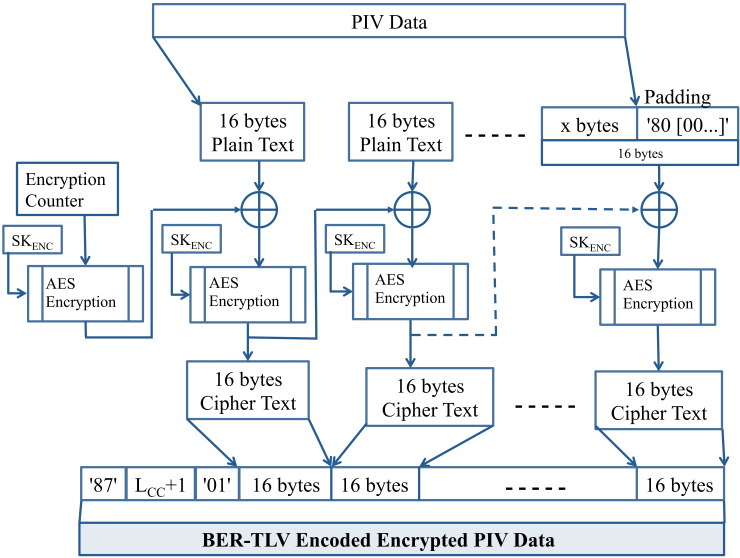
Figure 1:Fig. 1. PIV data confidentiality
Initialization Vector (IV). The IV for the AES CBC encryption of command data SHALL be generated by applying the AES block cipher to a 16-byte encryption counter. The initial value of the encryption counter upon successful completion of the key establishment protocol SHALL be ‘00 00 00 00 00 00 00 00 00 00 00 00 00 00 00 01’. The encryption counter SHALL be incremented by one after each APDU sent over secure messaging (except for the GET RESPONSE command and APDUs with a CLA of 1C), and it SHALL be reset to its initial value after each successful completion of the key establishment protocol. The 16-byte IV SHALL be created by encrypting the encryption counter with SKENC using AES in the electronic codebook (ECB) mode of operation.
The IV for the AES CBC encryption of response data SHALL also be generated by encrypting an encryption counter with SKENC using AES in the ECB mode of operation. The encryption counter value used to generate the IV to encrypt the response data SHALL be the same as the encryption counter value used to generate the IV to encrypt the corresponding request data, with the exception that the most significant byte of the 16-byte counter SHALL be set to 80 (i.e., the IV used to encrypt the first response after successful completion of the key establishment protocol SHALL be generated by encrypting ‘80 00 00 00 00 00 00 00 00 00 00 00 00 00 00 01’ with SKENC).
Padding. Prior to encryption, 1 – 16 bytes of padding data SHALL be appended to the PIV data. The padding SHALL be 80 followed by the number of zeros needed to make the total length of the message to be encrypted (i.e., PIV data plus padding) a multiple of 16 bytes. The first byte of the value field of tag 87 — the padding content indicator byte — SHALL be 01 to indicate that padding has been applied.
As illustrated in Figure 1, the input and output of encryption are as follows:
Encryption input:
Plain Text
Encryption output:
BER-TLV-encoded encrypted message, which consists of tag
87followed by the length of the encoded encrypted message (Lcc + 1), the padding indicator byte (01), and then the encrypted data. Lcc is the length of the encrypted PIV data; it SHALL be a multiple of 16.
4.2.3Command Integrity
The Command MAC (C-MAC) SHALL be generated by applying the cipher-based MAC (CMAC) 17 to the header and data field of a command using the SKMAC session key. If fragmentation is required for data transmission, the command SHALL be constructed without fragmentation for the purposes of computing the MAC, and the CLA byte used in the computation of the MAC SHALL be 0C.
The data to be MACed, MC-MAC, SHALL be constructed by concatenating the following:
The 16-byte MAC chaining value (MCV). For the first command sent after successful completion of the key establishment protocol the MCV consists of 16 bytes of
00. For each subsequent command the MCV is the 16-byte MAC value computed for the previous command.A 16-btye encoded header. The encoded header SHALL consist of the CLA byte (
0C), the INS byte, P1, and P2, followed by twelve bytes of padding, consisting of80followed eleven bytes of00. (The length of the data field, Lc, is not included in the data to be MACed.)The data field, which is the BER-TLV-encoded encrypted message.[20]
Le encapsulated in BER-TLV format with tag
97if the Le field is included in the command.[21]
Let TC-MAC = CMAC(SKMAC, MC-MAC), as described in NIST SP 800‑38B 17. The BER-TLV-encoded C-MAC for the command SHALL be the 8 most significant bytes of TC-MAC encapsulated in BER-TLV format with tag 8E. The entire 16-byte value TC-MAC will be the MCV for the next command.
Figure 2 illustrates how the C-MAC is generated for each command.
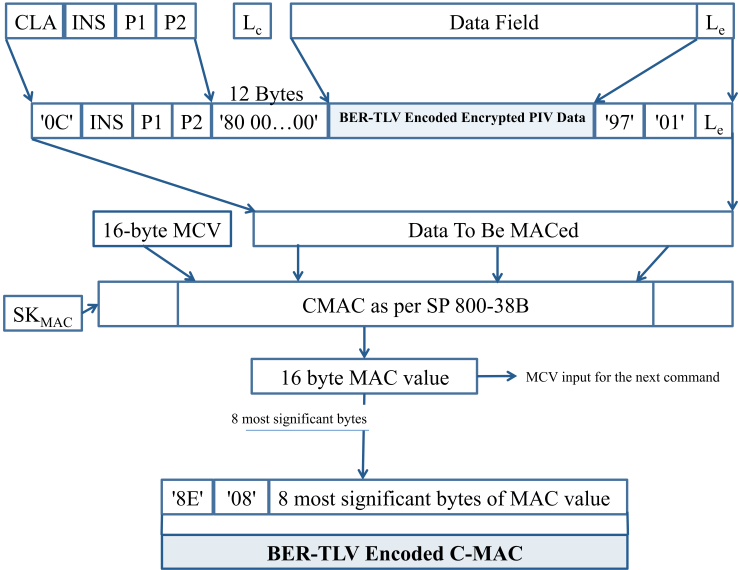
Figure 2:Fig. 2. PIV data integrity of command
4.2.4Command With PIV Secure Messaging
For secure messaging, the secure messaging data field SHALL be constructed as the concatenation of the following:
The BER-TLV-encoded encrypted PIV data;[22]
The 3-btye BER-TLV-encoded Le, as described in Section 4.2.3, if Le would have been included in a message sent without secure messaging;
The 10-byte BER-TLV-encoded C-MAC of the command, as described in Section 4.2.3; and
A new Le field, which SHALL be 1 byte and SHALL have a value of
00.[23]
Figure 3 shows the APDU for secure messaging when command chaining is not required. The APDU consists of the CLA byte (0C), INS, P1, P2, the length of the secure messaging data field (Lc’), the secure messaging data field, and the new Le field (00).

Figure 3:Fig. 3. Single command under secure messaging
Command chaining will be needed if the secure messaging data field to be transported is larger than 255 bytes. Figure 4 shows the APDUs for secure messaging when the length of the secure messaging data field is between 256 and 510 bytes, which requires the data to be fragmented across two APDUs. The APDUs are constructed in the same manner as when fragmentation is not required, except that the CLA byte for the first APDU is 1C, the first APDU contains the first 255 bytes of the secure messaging data field, and the second APDU contains the remaining bytes of the secure messaging data field and the new Le field (00). The PIV Card Application provides a 2-byte response of 90 00 for the first APDU. After receiving the second APDU, the PIV Card Application reconstructs and processes the entire command.
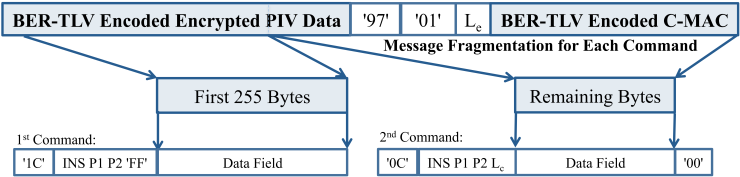
Figure 4:Fig. 4. Chained command under secure messaging
4.2.5Response Integrity
The response MAC (R-MAC) SHALL be generated by applying CMAC 17 to the data field and status bytes of the response using the SKRMAC session key. An R-MAC SHALL be generated for each response that corresponds to a command that was sent to the card using secure messaging.
The data to be MACed, MR-MAC, SHALL be constructed by concatenating the following:
The 16-byte MAC chaining value (MCV). For the first response sent after successful completion of the key establishment protocol the MCV consists of 16 bytes of
00. For each subsequent response the MCV is the 16-byte MAC value computed for the previous response.The data field (if present), which is the BER-TLV-encoded encrypted message
The status word, SW1, and SW2 encapsulated in BER-TLV format with tag
99
Let TR-MAC = CMAC(SKRMAC, MR-MAC), as described in NIST SP 800-38B 17. The BER-TLV-encoded R-MAC for the response SHALL be the 8 most significant bytes of TR-MAC encapsulated in BER-TLV format with tag 8E. The entire 16-byte value TR-MAC will be the MCV for the next response.
Figure 5 illustrates how the R-MAC is generated for the response.
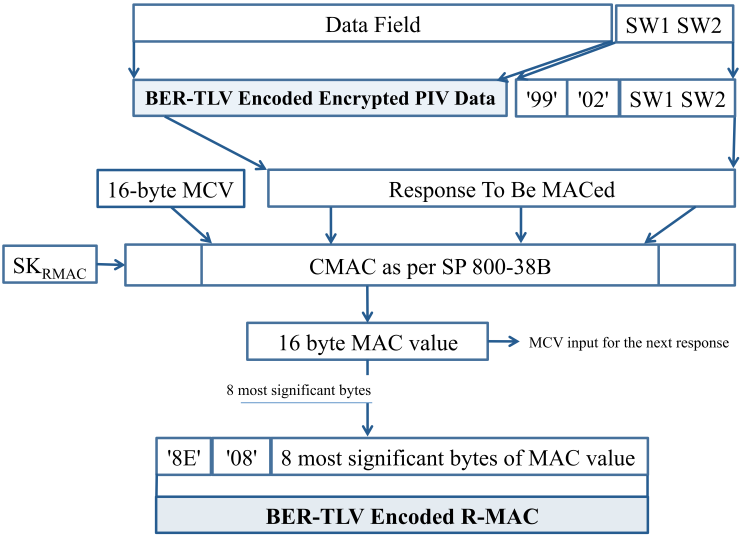
Figure 5:Fig. 5. PIV data integrity of response
4.2.6Response With PIV Secure Messaging
For secure messaging, the secure messaging data field that is sent by the PIV Card Application SHALL be constructed as the concatenation of the following:
The BER-TLV-encoded encrypted message (when present);
The 4-byte BER-TLV-encoded status word, as described in Section 4.2.5; and
The 10-byte BER-TLV-encoded R-MAC of the response, as described in Section 4.2.5.
Figure 6 illustrates a response under secure messaging when response chaining is not required. The APDU consists of the secure messaging data field and the 2-byte SW processing status (90 00), which indicates that the PIV Card Application successfully verified the C-MAC on the command and decrypted the data field in the command (if present). If the PIV Card Application was unable to verify the C-MAC on the command or decrypt the data field in the command, then it SHALL return a 2-byte error response, as described in Section 4.2.7.
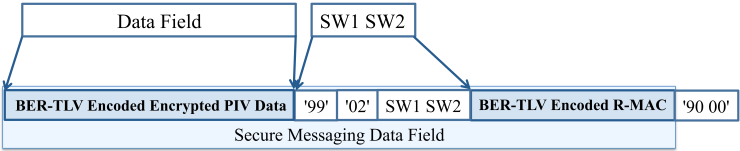
Figure 6:Fig. 6. Single response under secure messaging
Response chaining[24] will be needed if the secure messaging data field to be transported is larger than 256 bytes. Figure 7 shows the APDUs for secure messaging that are sent by the PIV Card Application when the length of the secure messaging data field is between 513 and 768 bytes, which requires the data to be fragmented across three APDUs. After the first response, an APDU of ‘00 C0 00 00 00’ will be sent to request the second response. After the second response, an APDU of ‘00 C0 00 00 xx’ will be sent to request the third response.
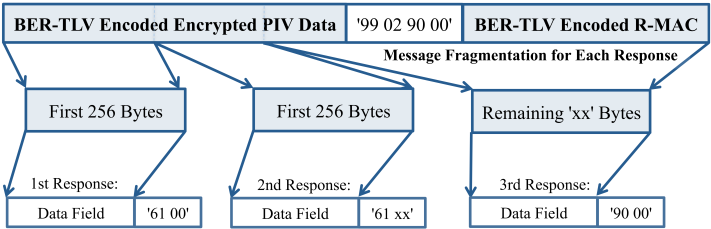
Figure 7:Fig. 7. Chained response under secure messaging
4.2.7Error Handling
The SW processing status is the status word of the overall secure messaging command and response processing. It indicates whether the secure messaging was performed successfully. If the processing was successful, it SHALL be 90 00. Otherwise, it SHALL be as follows:
68 82– Secure messaging not supported69 82– Security status not satisfied[25]69 87– Expected secure messaging data objects are missing69 88– Secure messaging data objects are incorrect
If the command processing was unsuccessful, the card SHALL return one of the above status words without performing further secure messaging.
4.3Session Key Destruction
The session keys established after successful execution of the key establishment protocol in Section 4.1 SHALL be zeroized in the following circumstances:
The card is reset,
An error occurs in secure messaging,[26] or
New session keys are requested by the client application by sending a GENERAL AUTHENTICATE command to the card to perform the key establishment protocol using the PIV Secure Messaging key.
References
- Ferraiolo, H. (2024). Interfaces for Personal Identity Verification: National Institute of Standards and Technology. 10.6028/nist.sp.800-73pt2-5
- International Organization for Standardization/International Electrotechnical Commission. (2020). ISO/IEC 7816-4:2020 Identification cards – Integrated circuit cards – Part 4: Organization, security and commands for interchange. ISO/IEC. https://www.iso.org/standard/77180.html
- International Organization for Standardization/International Electrotechnical Commission. (2004). ISO/IEC 7816-5:2004 Identification cards – Integrated circuit cards – Part 5: Registration of application providers. ISO/IEC. https://www.iso.org/standard/34259.html
- International Organization for Standardization/International Electrotechnical Commission. (2023). ISO/IEC 7816-6:2023 Identification cards – Integrated circuit cards – Part 6: Interindustry data elements for interchange. ISO/IEC. https://www.iso.org/standard/77181.html
- International Organization for Standardization/International Electrotechnical Commission. (2021). ISO/IEC 7816-8:2021 Identification cards – Integrated circuit cards – Part 8: Commands and mechanisms for security operations. ISO/IEC. https://www.iso.org/standard/79893.html
- International Organization for Standardization/International Electrotechnical Commission. (2017). ISO/IEC 7816-9:2017 Identification cards – Integrated circuit cards – Part 9: Commands for card management. ISO/IEC. https://www.iso.org/standard/67802.html
- National Institute of Standards and Technology. (2022). Personal Identity Verification (PIV) of Federal Employees and Contractors (Federal Information Processing Standards Publication FIPS 201-3). U.S. Department of Commerce. 10.6028/NIST.FIPS.201-3
- International Organization for Standardization/International Electrotechnical Commission. (2015). ISO/IEC 8825-1:2015 Information technology – ASN.1 encoding rules: BER, CER, and DER – Part 1. ISO/IEC. https://www.iso.org/standard/81420.html
- International Organization for Standardization/International Electrotechnical Commission. (2021). ISO/IEC 8824-2:2021 Information technology – Abstract Syntax Notation One (ASN.1) – Part 2: Information object specification. ISO/IEC. https://www.iso.org/standard/81417.html
- Ferraiolo, H., & Regenscheid, A. (2024). Cryptographic Algorithms and Key Sizes for Personal Identity Verification (Techreport NIST SP 800-78-5). National Institute of Standards. 10.6028/NIST.SP.800-78-5
- National Institute of Standards and Technology. (2013). Biometric Specifications for Personal Identity Verification (NIST Special Publication SP 800-76-2). National Institute of Standards. 10.6028/NIST.SP.800-76-2
- Certicom Research. (2009). SEC 1: Elliptic Curve Cryptography (2.0) [Techreport]. Standards for Efficient Cryptography Group (SECG). https://www.secg.org/sec1-v2.pdf
- National Institute of Standards and Technology. (2018). Recommendation for Pair-Wise Key Establishment Schemes Using Discrete Logarithm Cryptography (NIST Special Publication SP 800-56A Rev. 3). National Institute of Standards. 10.6028/NIST.SP.800-56Ar3
- InterNational Committee for Information Technology Standards (INCITS). (2023). INCITS 504-1-2013 (R2023): Information Technology — Generic Identity Command Set — Part 1: Card Application Command Set. ANSI/INCITS Standard. https://webstore.ansi.org/standards/incits/incits5042013r2023
- National Institute of Standards and Technology. (2023). Digital Signature Standard (DSS) (Federal Information Processing Standards Publication FIPS 186-5). U.S. Department of Commerce. 10.6028/NIST.FIPS.186-5
AExamples of the Use of the GENERAL AUTHENTICATE Command
A.1Authentication of the PIV Card Application Administrator
The PIV Card Application Administrator is authenticated by the PIV Card Application using a challenge-response protocol. A challenge retrieved from the PIV Card Application is encrypted by the client application and returned to the PIV Card Application associated with key reference 9B, which is the key reference of the PIV Card Application Administration key. The PIV Card Application decrypts the response using this reference data and the algorithm associated with the key reference (e.g., AES-128 – ECB, algorithm identifier 08). If this decrypted value matches the previously provided challenge, then the security status indicator of the PIV Card Application Administration key is set to TRUE within the PIV Card Application.
The following shows the GENERAL AUTHENTICATE card commands sent to the PIV Card Application to realize this particular challenge-response protocol.
00 87 08 9B 04 7C 02 81 00 00
The client application requests a challenge from the PIV Card Application.
7C 12 81 10 01 02 03 04 05 06 07 08 09 0A 0B 0C 0D 0E 0F 10 90 00
The PIV Card Application returns the challenge 01 02 03 04 05 06 07 08 09 0A 0B 0C 0D 0E 0F 10.
00 87 08 9B 0C 7C 12 82 10 88 77 66 55 44 33 22 11 88 77 66 55 22 11 33 11
The client application returns the encryption of the challenge (88 77 66 55 44 33 22 11 88 77 66 55 22 11 33 11), referencing algorithm 08 and key reference 9B, per SP 800-78, Tables 8 and 9 10.
90 00
The PIV Card Application decrypts the response using the referenced algorithm and key, recovers 01 02 03 04 05 06 07 08 09 0A 0B 0C 0D 0E 0F 10, and indicates successful authentication of the PIV Card Application Administrator.
A.2Mutual Authentication of Client Application and Card Application
The PIV Card Application Administrator and the PIV Card Application authenticate each other using a challenge-response protocol. A witness retrieved from the PIV Card Application is decrypted by the client application and returned to the PIV Card Application associated with key reference 9B, the key reference of the PIV Card Application Administration key. The command includes the decrypted witness and a challenge for the PIV Card Application. The PIV Card Application verifies that the decrypted witness matches the value that it encrypted to create the witness. If it does, then the security status indicator of the PIV Card Application Administration key is set to TRUE within the PIV Card Application, and the PIV Card Application encrypts the challenge that it received from the client application and returns the result. The witness and challenge are encrypted and decrypted using the same the key and algorithm. The following shows the GENERAL AUTHENTICATE card commands sent to the PIV Card Application to realize mutual authentication using AES – ECB (algorithm identifier '08’).
00 87 08 9B 04 7C 02 80 00 00
The client application requests a witness from the PIV Card Application.
7C 12 80 10 88 77 66 55 44 33 22 11 88 77 66 55 22 11 33 11 90 00
The PIV Card Application returns a witness created by generating 16 bytes of random data (01 02 03 04 05 06 07 08 09 0A 0B 0C 0D 0E 0F 10) and encrypting them using the referenced key (9B) and algorithm (08), per SP 800-78, Tables 8 and 9 10.
00 87 08 9B 18 7C 24 80 10 01 02 03 04 05 06 07 08 09 0A 0B 0C 0D 0E 0F 10 81 10 09 0A 0B 0C 0D 0E 0F 10 09 08 07 06 05 04 03 02 82 00 00
The client application returns the decrypted witness (01 02 03 04 05 06 07 08 09 0A 0B 0C 0D 0E 0F 10), referencing algorithm 08 and key reference 9B, and requests encryption of challenge data (09 0A 0B 0C 0D 0E 0F 10 09 08 07 06 05 04 03 02) using the same key.
7C 12 82 10 11 FF EE DD CC BB AA 99 88 77 66 55 44 33 22 11 90 00
The PIV Card Application verifies the decrypted witness, confirming the Administrator, then returns the encrypted challenge (11 FF EE DD CC BB AA 99 88 77 66 55 44 33 22 11). The client application authenticates the PIV Card Application by decrypting the encrypted challenge and recovering 09 0A 0B 0C 0D 0E 0F 10 09 08 07 06 05 04 03 02.
A.3Authentication of PIV Cardholder
The PIV cardholder is authenticated by first retrieving and validating either the X.509 Certificate for PIV Authentication or the X.509 Certificate for Card Authentication. Assuming that the certificate is valid, the client application requests the PIV Card Application to sign a challenge using the private key associated with this certificate (i.e., key reference 9A or 9E) and the appropriate algorithm (e.g., algorithm identifier 07[27]), which CAN be determined from the certificate, as described in SP 800-73-5 Part 1, Appendix C.1. The response from the card is verified using the public key in the certificate. If the signature is verified, then the PIV cardholder is authenticated.
The following shows the GENERAL AUTHENTICATE card commands sent to the PIV Card Application to realize cardholder authentication when the X.509 Certificate for PIV Authentication includes a 2048-bit[28] RSA public key. It is assumed that the cardholder PIN or OCC data has been successfully verified prior to sending the GENERAL AUTHENTICATE command.
10 87 07 9A FF 7C 82 01 06 82 00 81 82 01 00 00 01 FF FF FF FF .. FF FF FF FF FF 00 9D F4 6E 09 E7 D6 19 18 53 1E 6E 1C 66 87 C4 3E CF FF 7D 53 47 BD 2E 93 19
(.. represents 208 bytes of challenge data.) The client application sends a challenge to the PIV Card Application indicating that the reference data associated with key reference 9A is to be used with algorithm 07 (see SP 800-78, Tables 9 and 10 10). The challenge data, encoded as specified for TLS 1.3 client authentication, is 00 01 FF ... 18 BC A7. Bit 5 of the CLA byte is set to one to indicate command chaining. is absent to indicate that no response data is expected.
90 00
The PIV Card Application indicates that it received the command successfully.
00 87 07 9A 0B 94 53 76 FE A7 91 72 14 18 BC A7 00
The client application sends the remaining data as the second and final command of the chain. is 00 to indicate that 256 bytes of response data are expected.
7C 82 01 04 82 82 01 00 29 69 44 3B 49 AC 5B 70 63 51 A1 5B B5 .. AD F7 0B 7D A6 4C 6C AA 62 40 C5 FA A8 7E A2 2B DC 92 18 56 8B CE F4 69 14 D9 83 61 08
(.. represents 208 bytes of response data.) The PIV Card Application returns the signature (29 69 44 3B 49 AC…). The final 2 bytes 61 08 indicate that 8 more bytes remain to be read.
00 C0 00 00 08
GET RESPONSE command requesting the remaining 8 bytes.
30 1B 11 06 AE E2 F1 2E 90 00
The PIV Card Application sends the remaining 8 bytes.
A.4Signature Generation With the Digital Signature Key
The GENERAL AUTHENTICATE command CAN be used to generate signatures. The pre-signature hash and padding (if applicable) are computed off-card. The PIV Card Application receives the hashed value of the original message, applies the private signature key (key reference 9C), and returns the resulting signature to the client application.
The card commands sent to the PIV Card Application to generate a signature are listed below. It is assumed that the cardholder PIN or OCC data has been successfully verified prior to sending the GENERAL AUTHENTICATE command.
A.4.1RSA
This example illustrates signature generation using RSA 2048[29] (i.e., algorithm identifier 07). Command chaining is used in the first command since the padded hash value sent to the card for signature generation is bigger than the length of the data field.
10 indicating command chaining
87
07
9C
Length of data field
7C L1 { 82 00 81 L2 {first part of the PKCS #1 v1.5 or PSS padded message hash value} }
Absent
Absent
90 00
00 (last command of the chain)
87
07
9C
Length of data field
{second and last part of the PKCS #1 v1.5 or PSS padded message hash value}
00
7C L1 { 82 L2 {first part of signature} }
61 xx, where xx indicates the number of response bytes remaining
00
C0
00
00
xx (length of remaining response as indicated by previous SW1-SW2)
{second and last part of signature}
90 00
A.4.2ECDSA
The following example illustrates signature generation with ECDSA using ECC: Curve P-256 (i.e., algorithm identifier 11). Command chaining is not used in this example, as the hash value fits into the data field of the command. Padding does not apply to ECDSA.
00
87
11
9C
Length of data field
7C L1 { 82 00 81 L2 {hash value of message} }
00
7C L1 { 82 L2 (r,s) }, where (r,s) is DER-encoded as Ecdsa-Sig-Value ::= SEQUENCE { r INTEGER, s INTEGER }. L1 is the length of the 82 TLV structure; L2 is the length of the DER-encoded value.
90 00
A.5Key Establishment Schemes With the PIV Key Management Key
FIPS 201 specifies a public key pair and associated X.509 Certificate for Key Management. The key management key (KMK) is further defined in SP 800-78, which defines two distinct key establishment schemes for the KMK:
RSA key transport and
Elliptic Curve Diffie-Hellman (ECDH) key agreement.
The use of the KMK for RSA key transport and ECDH key agreement is discussed in Appendices A.5.1 and A.5.2, respectively.
A.5.1RSA Key Transport
In general, RSA transport keys are used to establish symmetric keys, where a sender encrypts a symmetric key with the receiver’s public key and sends the encrypted key to the receiver. The receiver decrypts the encrypted key with the corresponding private key. The decrypted symmetric key is subsequently used by both parties to protect further communication between them. Many types of security protocols employ the RSA key transport technique, such as Secure/Multipurpose Internet Mail Extensions (S/MIME) for secure email.
A.5.1.1RSA Key Transport With the PIV KMK
As specified in SP 800-78, the on-card private KMK CAN be an RSA transport key that complies with PKCS#1 18. In the scenario described above, a sender encrypts a symmetric key with the public RSA transport key of the recipient’s KMK. The role of the on-card KMK private RSA transport key is to decrypt the sender’s symmetric key on behalf of the cardholder and provide it to the client application cryptographic module.
A.5.1.1.1GENERAL AUTHENTICATE Command
The card commands sent to the PIV Card to decrypt the symmetric key are listed below. It is assumed that the cardholder’s PIN or OCC data has been successfully verified prior to sending the GENERAL AUTHENTICATE command to the card.[30]
Command 1 — GENERAL AUTHENTICATE (first chain)
10 indicating command chaining
87
07
9D
Length of data field
7C L1 { 82 00 81 L2 {first part of C} }, where C is the ciphertext to be decrypted as defined in PKCS#1, Sections 7.1.2 and 7.2.2 18
Absent
Absent
90 00
00 (last command of the chain)
87
07
9D
Length of data field
{second and last part of ciphertext C to be decrypted}
00
7C L1 { 82 L2 {first part of encoded message EM} }, where EM is as defined in PKCS#1, Sections 7.1.2 and 7.2.2 18
61 xx, where xx indicates the number of response bytes remaining
00
C0
00
00
xx (length of remaining response as indicated by previous SW1-SW2)
{second and last part of encoded message EM}
90 00
A.5.2Elliptic Curve Cryptography Diffie-Hellman
An ECDH key agreement scheme does not send an encrypted symmetric key to the participating entities. Instead, the two entities involved in the key agreement scheme compute a shared secret by combining their ECC private key(s) with the other party’s public key(s). The resulting shared secret (Z) serves as an input to a key derivation function (KDF), which each entity independently invokes to derive a common secret key. The secret key MAY be used as a session key or to encrypt a session key.
A.5.2.1ECDH With the PIV KMK
The PIV Card supports ECDH key agreement by performing the elliptic curve cryptography cofactor Diffie-Hellman (ECC CDH) primitive (SP 80-56A, Section 5.7.1.2 13) using its ECC KMK private key and an ECC public key that is provided as input to the GENERAL AUTHENTICATE command. All other procedures required to complete key agreement are performed by the cardholder’s client application and its associated cryptographic module.
A.5.2.2GENERAL AUTHENTICATE Command
The sequence of commands to perform the ECC CDH primitive from SP 800-56A, Section 5.7.1.2 13, with the private ECC KMK is illustrated below for ECC: Curve P-256.
00
87
11
9D
Length of data field
7C – L1 {82 00 85 L2 { 04 || X || Y}}, where 04 || X || Y is the other party’s public key, a point on Curve P-256, encoded without the use of point compression, as described in 12, Section 2.3.3]. The length of each coordinate (X and Y) is 32 bytes. The value of L2 is 65 bytes.
00
7C – L1 {82 L2 {shared secret Z}}, where Z is the X coordinate of point P, as defined in SP 800-56A, Section 5.7.1.2 13; L2 is 32 bytes.
90 00 (Status word)
A.5.2.3PIV KMK-Specific ECDH Key Agreement Schemes
SP 800-56A describes five different ECDH key agreement schemes that a client application cryptographic module MAY implement. These schemes differ in the number of keys (i.e., 1 or 2) and the type of keys (i.e., ephemeral or static) used by each party. Since the PIV Card only computes the ECC CDH primitive using its static private key, the client application cryptographic module only employs the PIV Card to implement an ECDH key agreement scheme when the scheme involves the use of the cardholder’s static key pair. The ECDH key agreement schemes that involve the use of at least one party’s static key pair and, thus, MAY involve the use of the PIV Card are:
C(2e, 2s) — Each party has a static key pair and generates an ephemeral key pair per SP 800-56A, Section 6.1.1 13.
In this scheme, the information sent between the client application and the PIV Card is the same when acting as the initiator or the responder. The other party’s static public key is sent to the PIV Card, and a static shared secret is returned by the PIV Card in plaintext. Note that an ephemeral key pair is generated by the client application, and the private key of that key pair is combined with the other party’s ephemeral public key to produce an ephemeral shared secret.C(1e, 2s) — The initiator has a static key pair and generates an ephemeral key pair, while the responder has a static key pair SP 800-56A, Section 6.2.1 13.
When the cardholder is acting as the initiator, the other party’s static public key is sent to the PIV Card, and a static shared secret is returned in plaintext by the PIV Card. Note that, in this case, an ephemeral key pair is generated by the client application’s cryptographic module, and the corresponding ephemeral private key is combined with the other party’s static public key to produce a second shared secret.When the cardholder is acting as the responder, two public keys are sent by the client application to the PIV Card (i.e., the other party’s static and ephemeral public keys), and two shared secrets are returned in plaintext (i.e., the static shared secret and the ephemeral shared secret). Note that two GENERAL AUTHENTICATE commands are required to provide the two shared secrets to the client application’s cryptographic module.
C(1e, 1s) — The initiator only generates an ephemeral key pair, while the responder only has a static key pair per SP 800-56A, Section 6.2.2 13.
*In this scheme, the PIV Card is only employed by the client application if the cardholder is acting as the responder. In this case, the other party’s ephemeral public key is sent to the PIV Card, and the shared secret is returned by the PIV Card in plaintext.C(0e, 2s) — Both the initiator and responder use only static key pairs per SP 800-56A, Section 6.3 13.
In the C(0e, 2s) scheme, the information sent between the client application’s cryptographic module, and the PIV Card is the same when acting as the initiator or the responder. The other party’s static public key is sent to the PIV Card, and the static shared secret is returned in plaintext. Note that, for this scheme, the client application’s cryptographic module also generates a nonce when acting as the initiator of the scheme.
The C(2e, 0s) scheme does not involve the use of static keys, so the PIV Card would not be involved in the implementation of this scheme.
A.6Authentication of the PIV Cardholder Over the Virtual Contact Interface
If the PIV Card supports the virtual contact interface, then all non-card management operations of the PIV Card Application MAY be performed over the contactless interface. In order to perform an operation that would otherwise be restricted to the contact interface, the key establishment protocol in Section 4.1 needs to be performed to establish session keys for secure messaging, and the pairing code needs to be submitted over secure messaging in order to establish a virtual contact interface.[31]
This appendix shows an example of the establishment of a VCI and its use to perform cardholder authentication using the PIV Authentication key. First, the GENERAL AUTHENTICATE command is used to perform the key establishment protocol. The VERIFY command is then used to submit the pairing code and establish the VCI. At that point, the GET DATA command is used to read the X.509 Certificate for PIV Authentication. The GENERAL AUTHENTICATE command is used to perform a challenge/response with the PIV Authentication key after the PIN is submitted using the VERIFY command.
Phase 1: Key Establishment
00 87 27 04 50 7C 4E 81 4A 00 00 00 00 00 00 00 00 00 04 X Y 82 00 00
GENERAL AUTHENTICATE to perform key establishment (cipher suite CS2), where is all zeros and X, Y are the 32-byte coordinates of . See Section 4.1.8.
7C L1 82 L2 00 N_ICC AuthCryptogram_ICC C_ICC
Key establishment response per Section 4.1.8, where and are 16 bytes each and is as specified in Section 4.1.5.
After the client application verifies , the authentication cryptogram, and the certificate(s) needed to verify the signature on , the PIV Card is authenticated and session keys , , and are established.
Phase 2: Pairing Code Submission
The VERIFY command is used to submit the pairing code (“65135275”) to the PIV Card Application. For the command,
0C 20 00 98 1D 87 11 01 ENC_C1 8E 08 T_8(T_C-MAC,1) 00
VERIFY over secure messaging to submit the pairing code (“65135275”) to the card.
99 02 90 00 8E 08 T_8(T_R-MAC,1) 90 00
The command was successfully executed and the VCI has been established.
Phase 3: Certificate Retrieval
Once the VCI has been established, the GET DATA command MAY be used to retrieve the X.509 Certificate for PIV Authentication. For the command,
computed using as MCV.
AES-encrypt of the PIV Authentication X.509 Certificate BER-TLV (tag 53)
computed using as MCV.
0C CB 3F FF 20 87 11 01 ENC_C2 97 01 00 8E 08 T_8(T_C-MAC,2) 00
GET DATA over VCI requesting the X.509 Certificate for PIV Authentication.
87 82 05 91 01 <bytes 1–251 of ENC_R2> 61 00
Returns the BER-TLV tag, length, and padding indicator (01), the first 251 bytes of the encrypted response, and an indicator that at least 256 additional bytes are available.
00 C0 00 00 00
Request the next 256 bytes.
<bytes 252–507 of ENC_R2> 61 00
Returns the next 256 bytes.
(GET RESPONSE repeated as needed…)
00 C0 00 00 A3
Request the final 163 bytes.
<bytes 1276–1424 of ENC_R2> 99 02 90 00 8E 08 T_8(T_R-MAC,2) 90 00
Returns the final 163 bytes, the BER-TLV-encoded status word, and the R-MAC.
Phase 4: PIN Retry Counter Check
At this point the PIV Card Application PIN could be submitted directly, but for illustration a VERIFY command is first sent without a data field to retrieve the current retry counter value.
0C 20 00 80 0A 8E 08 T_8(T_C-MAC,3) 00
VERIFY over SM to retrieve the number of remaining retries for the PIV Card Application PIN.
99 02 63 C3 8E 08 T_8(T_R-MAC,3) 90 00
Three additional retries are allowed (63 C3).
Phase 5: PIN Submission
The VERIFY command is used to submit the PIV Card Application PIN to the PIV Card Application. Other than the key reference and the PIN value, the command and response are the same as when using the VERIFY command to submit the pairing code. For the command,
computed using as MCV.
computed using as MCV.
Note: the encryption counter was incremented by the previous VERIFY command even though no encryption was performed.
0C 20 00 80 1D 87 11 01 ENC_C4 8E 08 T_8(T_C-MAC,4) 00
VERIFY over SM to submit the PIV Card Application PIN.
99 02 90 00 8E 08 T_8(T_R-MAC,4) 90 00
The command was successfully executed.
Phase 6: Challenge/Response Authentication
With the VCI established and PIN verified, privileged operations MAY now be performed over the contactless interface.
computed using as MCV.
The challenge is 7C 82 01 06 82 00 81 82 01 00 00 01 FF FF … BC A7 from Section A.3.
computed using as MCV.
The response is 7C 82 01 04 82 82 01 00 29 69 44 3B … E2 F1 2E from Section A.3.
1C 87 07 9A FF 87 82 01 11 01 <bytes 1–250 of ENC_C5>
GENERAL AUTHENTICATE: first part of the challenge, with command chaining.
90 00
First part received successfully.
0C 87 07 9A 23 <bytes 251–272 of ENC_C5> 97 01 00 8E 08 T_8(T_C-MAC,5) 00
Remaining challenge data, including the BER-TLV-encoded and C-MAC.
87 82 01 11 01 <bytes 1–251 of ENC_R5> 61 1B
First part of the signed challenge result. Padding indicator 01 indicates padding was applied. 61 1B indicates 27 more bytes remain.
00 C0 00 00 1B
Request the remaining 27 bytes.
<bytes 252–272 of ENC_R5> 99 02 90 00 8E 08 T_8(T_R-MAC,5) 90 00
Final portion of the signed challenge, with BER-TLV-encoded status word and R-MAC.
A.6.1Authentication of the PIV Cardholder Using SM-AUTH
PIV Cards that implement VCI or OCC use the key establishment protocol described Section 4.1 to establish a secure messaging key and subsequently protect communication between the PIV Card and the host. During the key establishment protocol, the PIV Card and the Cardholder are authenticated. Departments and agencies CAN use these authentication steps as a stand-alone authentication mechanism known as SM-AUTH.
The SM-AUTH authentication mechanism is performed with the GENERAL AUTHENTICATE command as follows:
00 87 27 04 50 7C 4E 81 4A 00 00 00 00 00 00 00 00 00 04 X Y 82 00 00
GENERAL AUTHENTICATE to perform key establishment (cipher suite CS2), where is all zeros and X, Y are the 32-byte coordinates of . See Section 4.1.8.
7C L1 82 L2 00 N_ICC AuthCryptogram_ICC C_ICC
Key establishment response per Section 4.1.8, where and are 16 bytes each and is as specified in Section 4.1.5.
After the client application verifies , the authentication cryptogram, and the certificate(s) needed to verify the signature on , the PIV Card is authenticated and session keys , , and are established. The session keys are then zeroized since they are not used[32] in subsequent communication.
BList of Symbols, Abbreviations, and Acronyms
- AES
- Advanced Encryption Standard
- AID
- Application Identifier
- APDU
- Application Protocol Data Unit
- API
- Application Programming Interface
- APT
- Application Property Template
- ASCII
- American Standard Code for Information Interchange
- ASN.1
- Abstract Syntax Notation One
- BER
- Basic Encoding Rules
- BIT
- Biometric Information Template
- CLA
- Class (first) byte of a card command
- CMAC
- Cipher-Based Message Authentication Code
- C-MAC
- Command Message Authentication Code
- CVC
- Card Verifiable Certificate
- DER
- Distinguished Encoding Rules
- ECB
- Electronic Codebook
- ECC
- Elliptic Curve Cryptography
- ECDSA
- Elliptic Curve Digital Signature Algorithm
- ECDH
- Elliptic Curve Diffie-Hellman
- EC CDH
- Elliptic Curve Cryptography Cofactor Diffie-Hellman
- FIPS
- Federal Information Processing Standard
- FISMA
- Federal Information Security Management Act
- HSPD
- Homeland Security Presidential Directive
- ICC
- Integrated Circuit Card
- IEC
- International Electrotechnical Commission
- IETF
- Internet Engineering Task Force
- INS
- Instruction (second) byte of a card command
- INCITS
- InterNational Committee for Information Technology Standards
- ISO
- International Organization for Standardization
- ITL
- Information Technology Laboratory
- KDF
- Key Derivation Function
- LSB
- Least Significant Bit
- MAC
- Message Authentication Code
- MSB
- Most Significant Bit
- MCV
- MAC Chaining Value
- NIST
- National Institute of Standards and Technology
- OCC
- On-Card Biometric Comparison
- OID
- Object Identifier
- OMB
- Office of Management and Budget
- OPACITY
- Open Protocol for Access Control, Identification, and Ticketing with privacY
- P1
- First parameter of a card command
- P2
- Second parameter of a card command
- PKCS
- Public-Key Cryptography Standards
- PIN
- Personal Identification Number
- PIV
- Personal Identity Verification
- PIX
- Proprietary Identifier extension
- PUK
- PIN Unblocking Key
- RFU
- Reserved for Future Use
- RID
- Registered Application Provider Identifier
- R-MAC
- Response Message Authentication Code
- RSA
- Rivest–Shamir–Adleman
- SM
- Secure Messaging
- S/MIME
- Secure/Multipurpose Internet Mail Extensions
- SP
- Special Publication
- SW1
- First byte of a 2-byte status word
- SW2
- Second byte of a 2-byte status word
- TLS
- Transport Layer Security
- TLV
- Tag-Length-Value
- VCI
- Virtual Contact Interface
CGlossary
- application identifier
- A globally unique identifier of a card application, as adapted from ISO/IEC 7816-4 2.
- algorithm identifier
- A 1-byte identifier that specifies a cryptographic algorithm and key size. For symmetric cryptographic operations, the algorithm identifier also specifies a mode of operation (i.e., ECB).
- authenticable entity
- An entity that can successfully participate in an authentication protocol with a card application.
- BER-TLV data object
- A data object coded according to ISO/IEC 8824-2:2021 9.
- card
- An integrated circuit card.
- card application
- A set of data objects and card commands that can be selected using an application identifier.
- card management operation
- Any operation involving the PIV Card Application Administrator.
- Card Verifiable Certificate
- A certificate stored on the card that includes a public key, the signature of a certification authority, and the information needed to verify the certificate.
- data object
- An item of information seen at the card command interface for which is specified a name, a description of logical content, a format, and a coding.
- key reference
- A 1-byte identifier that specifies a cryptographic key according to its PIV Key Type. The identifier is part of cryptographic material used in a cryptographic protocol, such as an authentication or a signing protocol.
- MAC Chaining Value
- A 16-byte value that is an input to the CMAC function and used to detect communication errors in duplicate or missing commands.
- object identifier
- A globally unique identifier of a data object, as adapted from ISO/IEC 8824-2:2021 9.
- reference data
- Cryptographic material used in the performance of a cryptographic protocol, such as an authentication or a signing protocol. The reference data length is the maximum length of a password or PIN. For algorithms, the reference data length is the length of a key.
- status word
- Two bytes returned by an integrated circuit card after processing any command that signify the success of or errors encountered during said processing.
- template
- A (constructed) BER-TLV data object whose value field contains specific BER-TLV data objects.
DNotation
The 16 hexadecimal digits SHALL be denoted using the alphanumeric characters 0, 1, 2, …, 9, A, B, C, D, E, and F. A byte consists of two hexadecimal digits, such as 2D. The two hexadecimal digits are represented in quotations 2D or as 0x2D. A sequence of bytes MAY be enclosed in single quotation marks (e.g., ‘A0 00 00 01 16’) rather than given as a sequence of individual bytes (e.g., A0 00 00 01 16).
A byte can also be represented by bits b8 to b1, where b8 is the most significant bit (MSB) and b1 is the least significant bit (LSB) of the byte. In textual or graphic representations, the leftmost bit is the MSB. Thus, for example, the most significant bit b8 of 80 is 1, and the least significant bit b1 is 0.
All bytes specified as RFU SHALL be set to 00, and all bits specified as RFU SHALL be set to 0.
All lengths SHALL be measured in number of bytes unless otherwise noted.
The expression ‘X’ & ‘Y’ is a bitwise AND operation between bytes ‘X’ and ‘Y’.
The symbol || means concatenation of byte strings. For example, if X is ‘00 01 02’ and Y is ‘03 04 05’, then X || Y is ‘00 01 02 03 04 05’.
Data objects in templates are described as being mandatory (M), optional (O), or conditional (C). Mandatory means that the data object SHALL appear in the template. Optional means that the data object MAY appear in the template. For conditional data objects, the conditions under which they are required are provided.
In other tables, the M/O/C column identifies properties of the PIV Card Application that SHALL be present (M), may be present (O), or are conditionally required to be present (C).
BER-TLV data object tags are represented as byte sequences, as described above. Thus, for example, 0x4F is the interindustry data object tag for an application identifier, and 0x7F60 is the interindustry data object tag for the Biometric Information Templates Group template.
This document uses the following typographical conventions in text:
ASN.1 data types are represented in a monospaced font. For example, SignedData and SignerInfo are data types defined for digital signatures.
Specific terms in CAPITALS represent normative requirements. When these same terms are not in CAPITALS, the term does not represent a normative requirement.
The terms SHALL and SHALL NOT indicate requirements to be strictly followed in order to conform to the publication and from which no deviation is permitted.
The terms SHOULD and SHOULD NOT indicate that among several possibilities, one is recommended as particularly suitable without mentioning or excluding others, that a certain course of action is preferred but not necessarily required, or that — in the negative form — a certain possibility or course of action is discouraged but not prohibited.
The terms MAY and NEED NOT indicate a course of action that is permissible within the limits of the publication.
The terms CAN and CANNOT indicate a material, physical, or causal possibility or capability or — in the negative — the absence of that possibility or capability.
Acknowledgments
The authors — Hildegard Ferraiolo, Ketan Mehta, Salvatore Francomacaro, and Ramaswamy Chandramouli of NIST and Sarbari Gupta of Electrosoft Services, Inc. — gratefully acknowledge the contributions of David Cooper, James Dray, William MacGregor, Scott Guthery, Teresa Schwarzhoff, and Jason Mohler, who co-authored prior versions of this three-part publication. The authors also gratefully acknowledge and appreciate the many contributions from the public and private sectors whose thoughtful and constructive comments improved the quality and usefulness of this publication.
Access to the default application, its commands, and its objects occurs immediately after a warm or cold card reset without an explicit SELECT command.
The VERIFY command is only required to support command chaining if the PIV Card Application supports OCC.
The CHANGE REFERENCE DATA command is only required to support command chaining if the PIV Card Application supports OCC.
The VCI is explained in further details in SP 800-73-5 Part 1, Sec. 5.5.
The GET RESPONSE command is used in conjunction with GET DATA to read larger PIV data objects. The GET RESPONSE command is illustrated in Appendix A.4.1, Command 3.
The Lc value is
05for all PIV data objects except for the0x7Einterindustry tag (Discovery Object), which has an Lc value of03, and the0x7F61interindustry tag (Biometric Information Templates (BIT) Group Template), which has an Lc value of04.There is no retry counter associated with the pairing code, so the authentication method cannot be blocked for that key reference.
It is recommended that in this case the authentication data not be compared to the on-card reference data.
If P1=
00and Lc and the command data field are absent, the command can be used to retrieve the number of further retries allowed (63 CX) or to check whether verification is not needed (90 00).It is recommended that in this case the authentication data not be compared to the on-card reference data.
It is recommended that in this case the authentication data not be compared to the on-card reference data.
The PIV Card Application may be implemented to reset the retry counter associated with OCC data when new OCC data is loaded onto the card.
It is recommended that in this case the authentication data not be compared to the on-card reference data.
The GET RESPONSE command is used to return the complete result of the cryptographic operation with keys sizes such as 2048- or 3072-bits RSA. The GET RESPONSE command is illustrated in Appendix A.4.1, Command 3.
The protocol does not provide forward secrecy.
If the public key needed to verify the signature on appears in an Intermediate CVC, then verify the signatures on both and the Intermediate CVC and — using standards-compliant PKI validation — validate the content signing certificate needed to verify the signature on the Intermediate CVC.
Validation of the content signing certificate does not need to be performed at the time of signature verification if the certificate has been previously validated or if the public key needed to verify the signature on has been previously obtained from a trusted source.
The PIV Card Application may perform full public-key validation instead SP800-56A, Section 5.6.2.3.2.
If the public key needed to verify the signature on the secure messaging CVC appears in an Intermediate CVC, then the Issuer Identification Number SHALL be the value of the Subject Identifier in the Intermediate CVC.
The data field may be absent in the case of the VERIFY command.
As noted in Section 3.1.2 and Section 3.2.4, the value of Le will always be
00when it is present.The data field may be absent in the case of the VERIFY command.
Note that the new Le field is always included in the command — even if Le would have been absent if the command were sent without secure messaging — since a response is always expected, even if the expected response only consists of the BER-TLV-encoded status word and response MAC (R-MAC).
Response chaining is accomplished by issuing several GET RESPONSE commands to the card.
Status word
69 82is used when secure messaging is requested but no session keys have been established.An error has occurred in secure messaging if the SW processing status in the response to a command sent with secure messaging is other than ‘61 XX’ or
90 00.Higher strength keys are advised starting in 2031, per SP 800-56 Part 1. See SP 800-78-5 Tables 9 and 10, which reflect support for higher strength keys for PIV cards and supporting systems, where applicable.
Higher strength keys are advised starting in 2031, per SP 800-56 Part 1. See SP 800-78-5 Tables 9 and 10, which reflect support for higher strength keys for PIV cards and supporting systems, where applicable.
Higher strength keys are advised per SP 800-56 Part 1 starting in 2031. See SP 800-78-5 Tables 9 and 10 which reflect support for higher strength keys for PIV cards and supporting system, where applicable.
Higher strength keys are advised starting in 2031, per SP 800-56 Part 1. See SP 800-78-5 Tables 9 and 10, which reflect support for higher strength keys for PIV cards and supporting systems, where applicable.
As noted in SP 800-73-5 Part 1, Section 5.5, the pairing code does not need to be submitted if the Bit 3 of the first byte of the PIN Usage Policy is set to one.
Bits b3 and b4 of the CLA byte are set to zero to indicate that further communication with the card will not be encrypted.