Super Intelligence (SI) in Additive Manufacturing (AM)
Explore the intersection of SI and 3D printing technologies. Learn how SI is revolutionizing design, optimization, and production in AM.
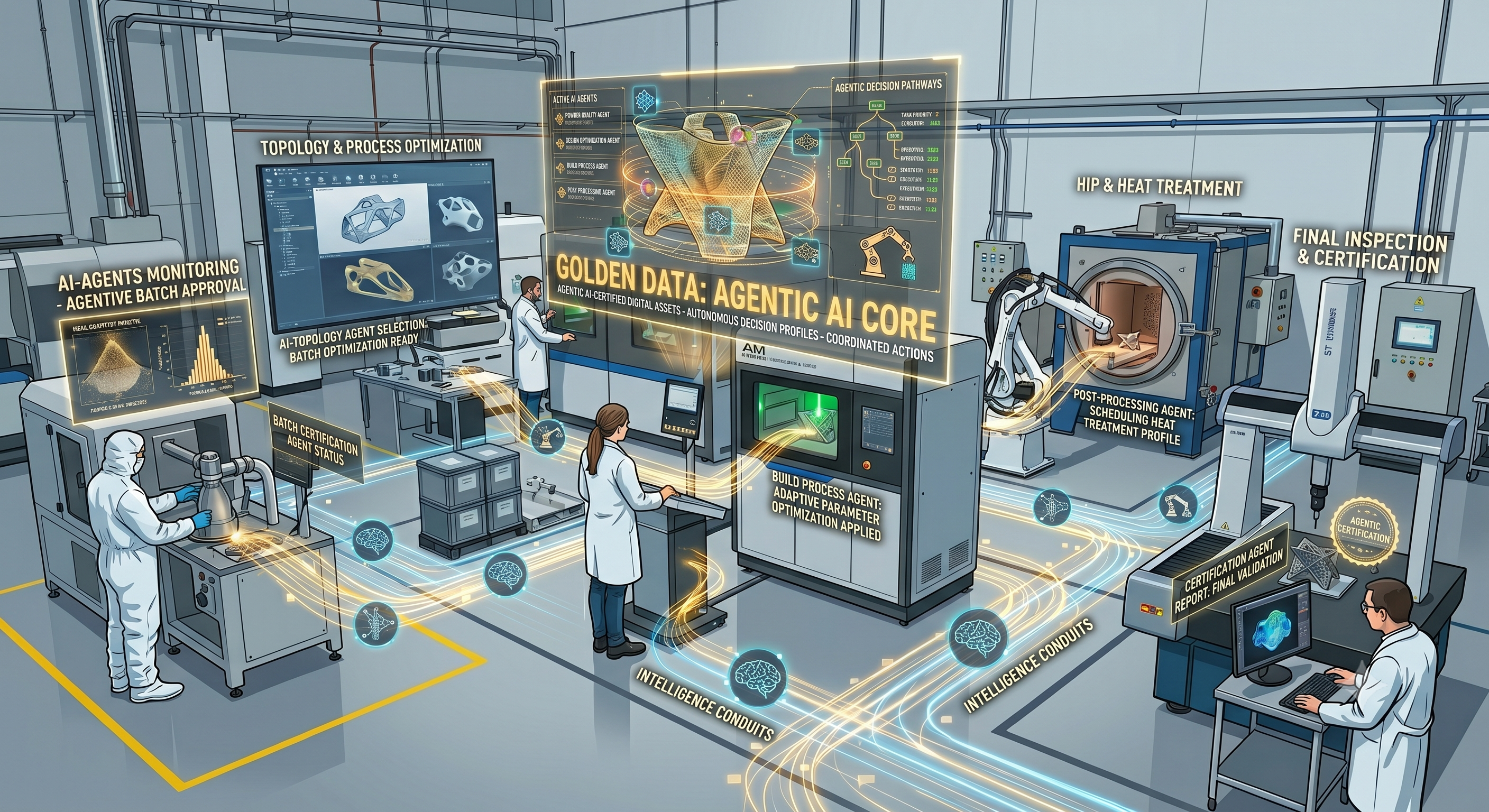
Overview
SI models are rapidly evolving fields with transformative potential for AM. This educational platform provides structured resources to help you understand, implement, and benefit from these technologies.
What is SI?
Learn about Super Intelligence models, including generative SI, their capabilities, and fundamental principles that drive this technology.
Learn MoreBenefits in AM
Discover how SI can enhance additive manufacturing through improved design, optimization, and production processes.
Explore BenefitsCurrent Landscape
Get a comprehensive overview of the current state of SI applications in the additive manufacturing industry.
View LandscapeUnderstanding SI Concepts in AM
To effectively apply SI in additive manufacturing, it's important to understand how different SI concepts relate to each other:
Foundation Models
A large-scale, general-purpose SI model pre-trained on massive and diverse datasets using heavy computing resources. It serves as a foundation that can be adapted or fine-tuned for many downstream tasks (generation, classification, search, reasoning). Includes LLMs, vision, audio, and multimodal models.
Generative SI Models
An SI model that creates new content — text, images, audio, video, or code — rather than only classifying or predicting. Most modern generative SI is built on top of foundation models, but smaller standalone generative models (e.g., early GANs) also exist.
Agentic SI
An SI system that autonomously plans, reasons, and executes multi-step tasks to achieve goals. It uses a generative/foundation model as its reasoning engine, but adds tool use, memory, and decision-making loops so it can act in real environments, not just produce content.
How They Work Together: Foundation models provide the underlying capabilities. Generative SI models build upon these to create new AM-specific content. Agentic SI systems use both foundation and generative models to autonomously perform complex manufacturing tasks.
Main Areas of Focus
Our content is structured into four comprehensive sections, each addressing different aspects of SI in AM:
Agentic SI for AM
Explore autonomous SI systems that can plan, reason, and execute complex manufacturing tasks in additive manufacturing.
ExploreSI Models Development
Explore foundation models and other SI models for additive manufacturing applications.
ExploreSI Agent
Learn about SI agent components, architectures, and control mechanisms for manufacturing systems.
ExploreData For SI
Access essential datasets, benchmarks, and evaluation metrics for SI in additive manufacturing.
Explore