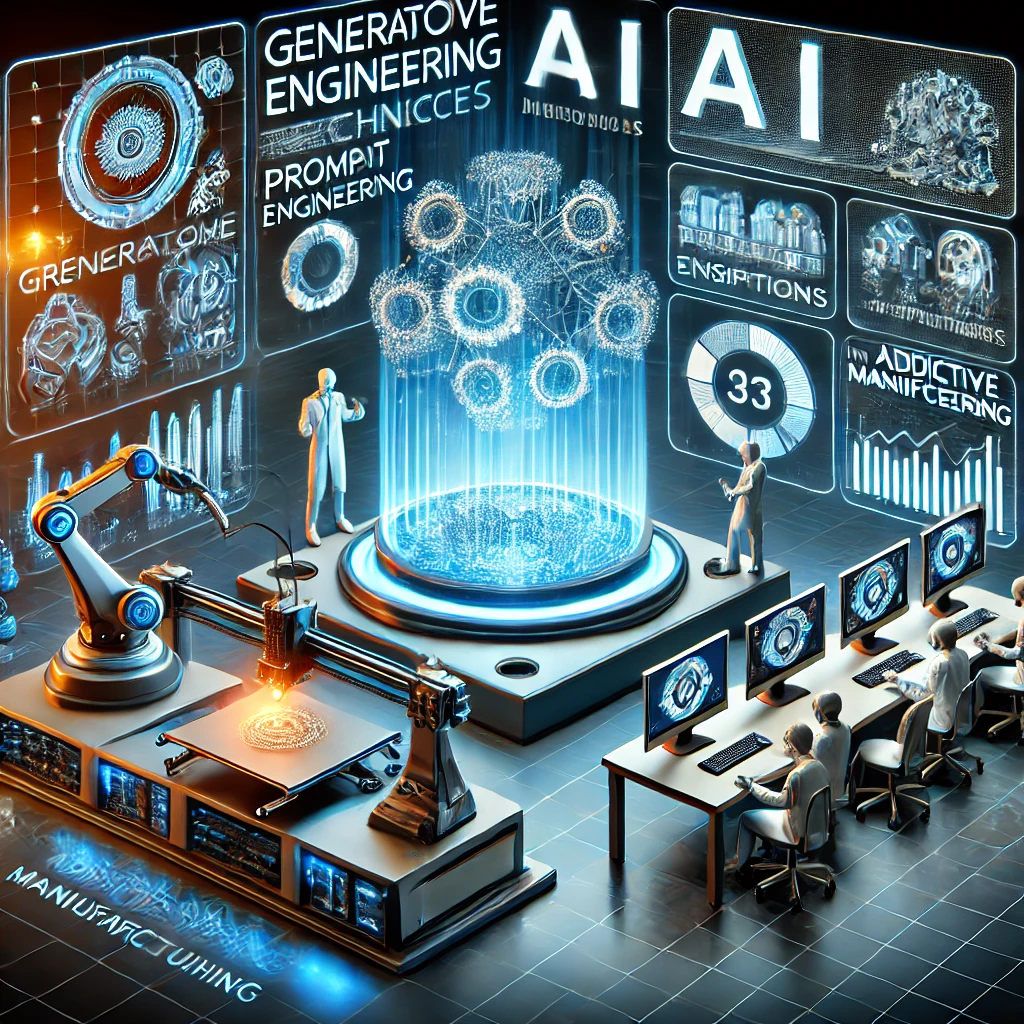
Definition & Overview
Understanding the core concepts of AI models is essential before exploring their specialized types. Below are the key definitions:
AI Model
A mathematical representation or algorithm that learns patterns from data to make predictions, decisions, or perform tasks. AI models range from simple linear regressions to complex neural networks.
Foundation Model
A large-scale, general-purpose AI model pre-trained on massive and diverse datasets using significant computing resources. It serves as a foundation that can be adapted or fine-tuned for many downstream tasks. Includes LLMs, vision, audio, and multimodal models.
Industrial Foundation Model
A foundation model specifically tailored for industrial applications, incorporating domain-specific knowledge from manufacturing, engineering, materials science, and related fields. These models understand technical drawings, process parameters, material properties, and production constraints, enabling them to assist in design optimization, predictive maintenance, and quality control.
Generative AI Model
A subset of AI models that creates new content — text, images, audio, video, 3D designs, or code — rather than only classifying or predicting. Most modern generative AI is built on top of foundation models, but smaller standalone generative models (e.g., early GANs) also exist.
AI Learning Approaches
AI systems can be categorized by how they learn and process information. Understanding these approaches helps in selecting the right AI technique for different additive manufacturing applications:
| Learning Approach | Description | Common Applications in AM |
|---|---|---|
| Supervised Learning | Models learn from labeled training data to make predictions or decisions. | Quality prediction, process optimization, defect classification |
| Unsupervised Learning | Models find patterns in data without explicit labels. | Process clustering, anomaly detection, material discovery |
| Reinforcement Learning | Models learn through interaction with an environment to maximize rewards. | Process control, parameter optimization, robotic assembly |
| Self-Supervised Learning | Models generate their own labels from input data, bridging supervised and unsupervised learning. | Foundation model pretraining, process monitoring, design generation |
Different AM applications may benefit from different learning approaches, and many modern AI systems combine multiple approaches for optimal performance.
Types of AI
AI encompasses several model architectures and approaches, each with distinct characteristics and applications in additive manufacturing:
Large Language Models (LLMs)
Text-focused AI systems like GPT-4 that can generate natural language, code, and even CAD descriptions. In AM, these can help with documentation, process planning, and even generating design specifications.
Examples: GPT-4, Claude, LLaMA
Diffusion Models
Models that gradually add and then remove noise from data to generate high-quality images. In AM, these can be adapted to generate 3D designs or optimized part topologies.
Examples: Stable Diffusion, DALL-E
Generative Adversarial Networks (GANs)
Two-network systems where one generates content and another evaluates it. Useful for creating realistic simulations of AM processes or generating new material structures.
Examples: StyleGAN, 3D-GAN
Variational Autoencoders (VAEs)
Neural networks that learn to encode data into a compressed representation and then decode it. Valuable for generating new designs that share characteristics with existing ones.
Examples: 3D-VAE, PointFlow
Foundation Models in Additive Manufacturing
Foundation models provide powerful starting points for AM applications due to their broad knowledge and adaptability. In the context of additive manufacturing, they can be specialized to understand engineering designs, process simulations, and material behaviors.
How Foundation Models Enable AM Innovation:
- Design Interpretation: Vision-language models can read CAD drawings and generate textual descriptions or suggest improvements.
- Process Optimization: Models trained on sensor data can predict optimal printing parameters for new geometries.
- Material Discovery: By learning from vast materials databases, foundation models can propose new alloy compositions with desired properties.
- Quality Prediction: Analyzing layer-by-layer images to detect defects before they propagate.
Adaptation Strategies for AM:
Zero-Shot Learning
Using the model directly without additional training, relying on its existing knowledge to perform AM-related tasks.
Few-Shot Learning
Providing a few examples in the prompt to guide the model toward the desired output format or style for AM applications.
Fine-Tuning
Additional training on AM-specific datasets (e.g., part designs, print logs, material test results) to adapt the model to the manufacturing domain.
Retrieval-Augmented Generation (RAG)
Combining the model with a knowledge base of AM information (standards, papers, process guides) to improve accuracy and relevance.
Applications in Additive Manufacturing
AI is finding numerous applications throughout the additive manufacturing workflow, ranging from design and optimization to monitoring and control:
Design Generation
Creating new 3D designs from text descriptions, reference images, or functional requirements. AI can generate multiple design alternatives that meet specified constraints.
Example: Generating lightweight bracket designs based on load requirements and material constraints.
Topology Optimization
Optimizing part designs for specific manufacturing processes, material usage, and performance criteria.
Example: Creating lattice structures that minimize material while maintaining structural integrity.
Process Parameter Prediction
Recommending optimal printing parameters based on part geometry, material properties, and quality requirements.
Example: Determining ideal laser power, speed, and pattern for a metal AM part.
In-Process Monitoring
Analyzing real-time sensor data to detect anomalies and predict defects during the printing process.
Example: Identifying potential layer delamination based on thermal camera data.
Post-Processing Optimization
Generating strategies for finishing operations based on part requirements and current state.
Example: Determining optimal heat treatment cycles for specific metal alloys.
Technical Details
Understanding the technical foundations of AI helps in effectively applying these technologies to additive manufacturing problems:
Transformer Architecture
Many modern AI models are built on the transformer architecture, which uses self-attention mechanisms to process sequential data. This allows models to understand context and relationships within the data.
Attention Mechanisms
Attention mechanisms allow models to focus on different parts of the input when generating each element of the output. This is crucial for maintaining coherence in generated content.
def self_attention(query, key, value):
    # Calculate attention scores
    scores = query @ key.transpose(-2, -1)

    # Scale scores
    scores = scores / math.sqrt(key.shape[-1])

    # Apply softmax to get attention weights
    weights = softmax(scores, dim=-1)

    # Apply attention weights to values
    output = weights @ value

    return output
Training Strategies
AI models for AM often require specialized training approaches:
- Transfer Learning: Starting with a general model and adapting it to AM-specific tasks
- Domain Adaptation: Techniques to bridge the gap between general data and AM-specific applications
- Data Augmentation: Generating synthetic training examples to improve model robustness
- Multi-modal Training: Combining different data types (text, images, 3D models) for comprehensive understanding
Evaluation Metrics
Assessing the performance of AI models in AM requires specialized metrics:
- Geometric Accuracy: How closely AI-generated or AI-assisted designs match specifications
- Functional Performance: How well AI-generated or AI-assisted designs fulfill their intended function
- Manufacturability: Whether the designs can be successfully printed
- Material Efficiency: Optimization of material usage while maintaining performance
- Novelty and Diversity: The novelty, originality, and practical value of AI-generated or AI-assisted designs