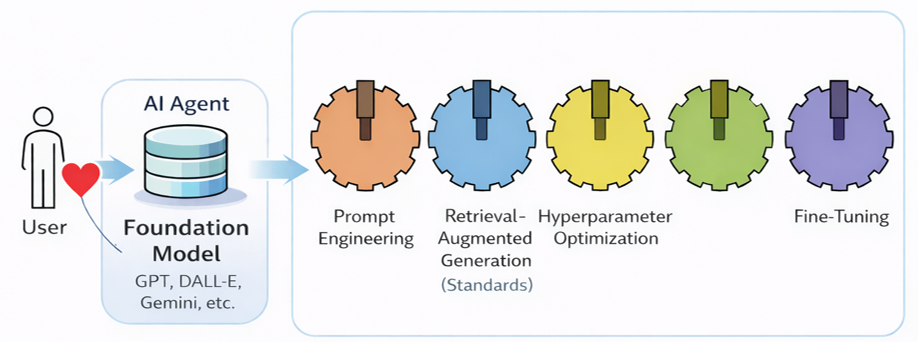
Integrating Development Approaches for AM
To build effective agentic AI systems for additive manufacturing, combine various development techniques to address domain‑specific challenges.
🎯 Domain‑Specific Prompt Engineering
Craft prompts that incorporate AM‑specific terminology, process knowledge, and manufacturing constraints so the model generates outputs aligned with AM workflows, material properties, and production requirements.
🔧 AM‑Focused Fine‑Tuning
Adapt models using manufacturing datasets that include print parameters, material behaviors, quality metrics, and failure patterns. This ensures the AI understands the nuances of different AM technologies (FDM, SLA, SLS, etc.) and materials.
🔌 AM Toolchain Integration
Connect AI models with AM‑specific tools such as slicing software (Cura, PrusaSlicer), simulation tools (ANSYS, Simcenter), CAD systems, and printer APIs to create seamless workflows from design to production.
⚙️ Process‑Optimized Hyperparameters
Tune parameters like temperature, learning rate, and batch size based on AM‑specific requirements such as print time constraints, material thermal properties, and quality‑assurance needs.
📚 AM‑Specific RAG Implementation
Enhance model responses with access to AM‑specific knowledge bases including material data sheets, process guidelines, design rules for AM, and quality standards (ASTM, ISO) relevant to additive manufacturing.
🧠 Artificial Narrow Intelligence (ANI)
Most effective agentic AI systems in AM leverage ANI principles by focusing on specific manufacturing tasks rather than pursuing general intelligence. This yields specialized expertise, predictable performance, efficient resource use, and easier regulatory compliance.
Domain‑Specific Implementation Framework
Follow this step‑by‑step framework to develop agentic AI solutions for your specific AM use case.
- Analyze Your AM Workflow: Map out your specific additive manufacturing process from design to post‑processing, identifying decision points where AI can add value.
- Define AM‑Specific Objectives: Establish clear goals such as reducing print failures, optimizing material usage, decreasing production time, or improving part quality.
- Select AM‑Aligned Techniques: Choose which development approaches (prompt engineering, fine‑tuning, toolchain integration, hyperparameter optimization, RAG, etc.) best address your specific challenges.
- Build AM Knowledge Base: Curate datasets, process guides, and material information specific to your AM operations.
- Develop Integrated Agent: Combine the selected techniques into a cohesive system that interacts with your AM equipment and software.
- Validate in AM Context: Test the agent with actual print jobs, material samples, and production scenarios.
- Iterate Based on AM Feedback: Continuously improve based on print results, quality measurements, and operator feedback.
AI Agents in AM
Examining successful AI implementations in additive manufacturing reveals practical technical approaches, integration methods, and measurable outcomes.
- Process Optimization: AI agents predict optimal laser power, scan speed, and layer thickness to minimize defects and maximize build rate.
- Real‑Time Defect Detection: Vision‑based models identify porosity, cracking, or warping during the build and trigger corrective actions.
- Material Behavior Modeling: AI forecasts how powders will melt and solidify, enabling proactive parameter adjustments.
- Quality Prediction: Models estimate final part mechanical properties and surface finish from in‑process sensor data.
These examples illustrate how integrating the development approaches and framework above yields tangible benefits in AM workflows.